

Driving is more than getting somewhere; it shapes everyday language and conversation. In English idioms, driving idioms and car idioms often describe control, speed, direction, risk, and progress. These idiomatic expressions add vivid description and figurative language to everyday situations. They help connect literal meaning with ideas about thoughts, emotions, and actions.
This guide explores useful idioms for driving, driving expressions, and road idioms in clear contexts. You will find idiom meanings, idiom examples, usage notes, and natural examples for spoken English and practical English. Whether you are learning idioms or improving English speaking, these expressions can make conversations smoother. You will also see how car culture and American English influence expressions connected to driving and travel.
What Is an Idiom?
An idiom is a fixed or commonly recognized expression whose overall meaning cannot always be understood by simply interpreting each word literally.
For example, “break the ice” does not mean physically breaking ice. It means to make people feel more comfortable in a new or awkward situation. Likewise, “spill the beans” means to reveal a secret, not to drop a container of beans.
The difference between literal and figurative meaning is what makes idioms interesting. English learners sometimes find them confusing because the individual words may suggest a completely different idea from the expression as a whole.
How Is an Idiom Different From a Metaphor or Simile?
These forms of figurative language are related, but they are not identical.
- Idiom: A recognized expression with a conventional figurative meaning. Example: “hit the road” means to leave or begin a journey.
- Metaphor: A direct comparison in which one thing is described as another. Example: “The road was a ribbon of silver.”
- Simile: A comparison using words such as like or as. Example: “The car moved like a cheetah.”
- Literal expression: Words are used in their ordinary meaning. Example: “She drove to work at eight o’clock.”
A useful rule is that not every creative phrase about driving is an idiom. A writer can invent a vivid metaphor, but an established idiom has a recognized conventional meaning.
Why Use Idioms for Driving?
Driving naturally gives English speakers images of roads, wheels, gears, brakes, lanes, speed, direction, and control. Those images can make abstract ideas easier to understand.
For example, saying someone is “in the driving seat” creates a stronger image of control than simply saying that person is responsible. Similarly, “steer clear of trouble” turns the idea of avoidance into a picture of guiding a vehicle away from danger.
Driving-related idioms can help you:
- Express speed and urgency more vividly.
- Describe control or responsibility.
- Talk about avoiding danger or problems.
- Add personality to everyday conversation.
- Make storytelling more memorable.
- Understand common figurative English.
- Recognize how physical driving experiences become figurative expressions.
The key is context. Some expressions are perfectly natural in everyday conversation, while others are informal, regional, or mainly figurative.
Quick List of 20 Idioms
- Hit the Road
- In the Driving Seat
- Backseat Driver
- Ride Shotgun
- Burn Rubber
- Put the Pedal to the Metal
- Get Into Gear
- Shift Gears
- Put the Brakes On
- Steer Clear Of
- On the Right Track
- Off the Beaten Track
- Be at a Crossroads
- In the Fast Lane
- Drive Someone Up the Wall
- Drive a Hard Bargain
- Drive a Wedge Between
- Drive Something Home
- Drive Something Into the Ground
- Pave the Way
Hit the Road
Meaning:
“Hit the road” means to leave a place or begin a journey. Despite the word hit, the expression does not mean physically striking a road.
It is one of the most natural driving-related expressions for saying that it is time to leave.
In a Sentence:
“We’ve packed everything, so let’s hit the road before the traffic gets heavy.”
Other Ways to Say It:
- Leave
- Set off
- Head out
- Get going
Explanation:
The expression creates a simple image of someone starting a journey and getting onto the road. It can refer to driving, traveling by another vehicle, or simply leaving a place.
It often carries a sense of movement and readiness rather than urgency.
Best Use:
Everyday conversation, travel stories, informal messages, and casual storytelling.
Tone: Casual and informal. It is common in conversational English.
Common Mistake:
Do not assume hit means driving dangerously or crashing. In this expression, “hit the road” simply means to leave or start traveling.
See Also: 20 Idioms for Wasting Time (With Examples)
In the Driving Seat
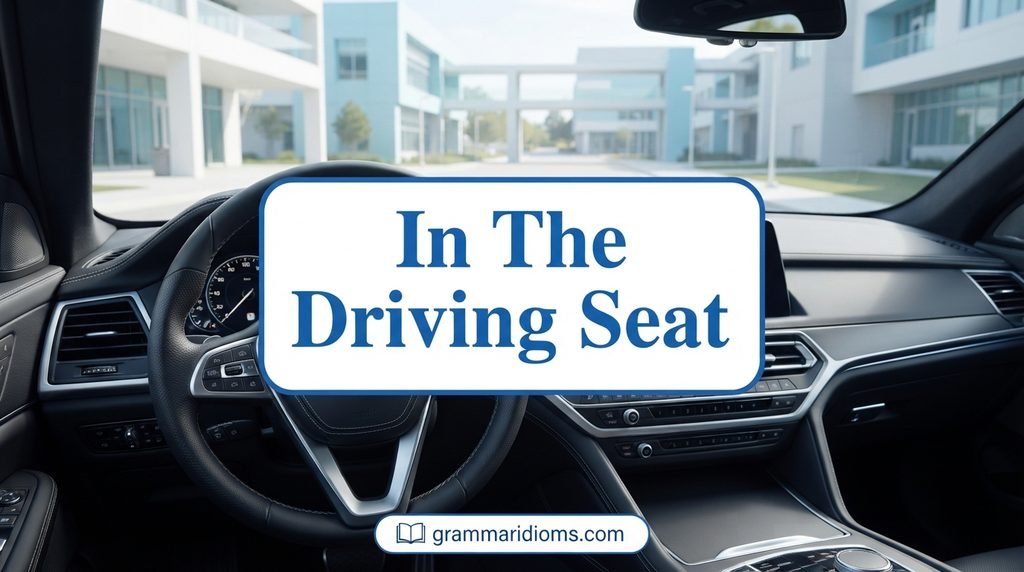
Meaning:
“In the driving seat” means to be in control of a situation or responsible for what happens. This is the usual British English form; American English commonly uses “in the driver’s seat.”
In a Sentence:
“After the new manager took over, she was firmly in the driving seat.”
Other Ways to Say It:
- In control
- In charge
- Calling the shots
- Holding the reins
Explanation:
The literal picture is a person sitting behind the steering wheel and controlling where the vehicle goes. Figuratively, that image represents authority, responsibility, and decision-making power.
The expression is especially useful when someone has gained control after previously having limited influence.
Best Use:
Everyday conversation, business writing, journalism, and discussions about responsibility or leadership.
Tone: Neutral and figurative. The British form is particularly natural in UK English.
Common Mistake:
Remember the regional difference. In British English, “in the driving seat” is standard. In American English, “in the driver’s seat” is more usual.
Backseat Driver
Meaning:
A “backseat driver” is someone who keeps giving unwanted advice, directions, or criticism to the person who is driving. The expression can also describe someone who tries to control a situation without actually being responsible for it.
In a Sentence:
“My brother becomes a terrible backseat driver whenever I take him on a long trip.”
Other Ways to Say It:
- Unwanted adviser
- Meddler
- Interfering person
- Overly critical passenger
Explanation:
The literal image is easy to recognize: someone sitting behind the driver while constantly commenting on how the car should be driven. The figurative use extends that image to people who interfere from the sidelines.
It usually has a mildly negative or humorous feeling.
Best Use:
Casual conversation, humorous storytelling, family situations, and informal writing.
Tone: Informal, humorous, and sometimes critical.
Common Mistake:
A backseat driver does not have to be literally sitting in the back of a car. The expression can also describe someone who tries to direct matters that are not really their responsibility.
Ride Shotgun
Meaning:
“Ride shotgun” means to sit in the front passenger seat of a car or truck. It is especially associated with North American informal English.
The expression can also have a broader meaning connected with accompanying or protecting someone.
In a Sentence:
“I called shotgun before anyone else could claim the front seat.”
Other Ways to Say It:
- Sit in the front seat
- Take the passenger seat
- Sit beside the driver
- Accompany the driver
Explanation:
The expression has historical associations with armed guards who traveled beside stagecoach drivers. In modern informal use, the most familiar meaning is simply riding in the front passenger seat.
Because of its cultural background, it can sound especially American.
Best Use:
Informal conversation, road trips, family travel, and casual storytelling.
Tone: Casual and informal. It is more common in North American English.
Common Mistake:
“Ride shotgun” does not normally mean that the passenger is actually carrying a shotgun. In modern everyday use, it usually refers to the front passenger seat.
Burn Rubber
Meaning:
“Burn rubber” means to drive very fast, especially when leaving quickly or accelerating hard.
In a Sentence:
“We’d better burn rubber if we’re going to reach the airport on time.”
Other Ways to Say It:
- Drive fast
- Speed away
- Take off quickly
- Race away
Explanation:
The expression creates a dramatic image of tires moving so aggressively that they heat up and produce smoke. It emphasizes speed and rapid movement rather than ordinary driving.
Because it suggests aggressive acceleration, it is not appropriate for careful or formal descriptions of safe driving.
Best Use:
Casual conversation, humorous stories, fiction, and informal descriptions of fast driving.
Tone: Informal and energetic.
Common Mistake:
“Burn rubber” is about driving very fast, not literally burning tires in ordinary usage.
Put the Pedal to the Metal

Meaning:
“Put the pedal to the metal” means to go at maximum speed or use maximum effort. In driving, it suggests pressing the accelerator hard.
In a Sentence:
“As soon as the road opened up, he put the pedal to the metal.”
Other Ways to Say It:
- Go full speed
- Step on it
- Go all out
- Give it everything you’ve got
Explanation:
The expression comes directly from the physical experience of pressing a vehicle’s accelerator pedal down toward the floor. Figuratively, the image represents maximum speed, effort, or determination.
It can describe both driving and non-driving situations.
Best Use:
Casual conversation, sports, motivational writing, informal storytelling, and descriptions of fast action.
Tone: Informal, energetic, and dramatic.
Common Mistake:
The correct word is “metal,” not “medal.” The expression refers to the vehicle’s metal floor or pedal-to-floor image, not an award.
Get Into Gear
Meaning:
“Get into gear” means to start working effectively or become active and productive. It comes from the literal idea of a machine or vehicle getting into the correct gear.
In a Sentence:
“We need to get into gear if we want to finish the project this afternoon.”
Other Ways to Say It:
- Get started
- Get moving
- Get organized
- Become productive
Explanation:
A vehicle cannot move properly in every mechanical state. The figurative expression transfers that idea to people and activities: once you get into gear, you begin making real progress.
It can describe an individual, a team, a project, or even a larger organization.
Best Use:
Everyday conversation, workplace discussions, informal writing, and discussions about productivity.
Tone: Casual and practical.
Common Mistake:
Do not use it only for physically changing gears. In figurative English, it usually means becoming active or effective.
Shift Gears
Meaning:
“Shift gears” means to change what you are doing, discussing, or focusing on, especially by moving suddenly from one approach to another.
In a Sentence:
“After discussing the budget, the meeting shifted gears and focused on customer service.”
Other Ways to Say It:
- Change direction
- Change focus
- Switch approaches
- Move to another topic
Explanation:
A driver shifts gears when the vehicle needs a different level of power or speed. English uses that mechanical image to describe a change in activity, mood, strategy, or conversation.
It can suggest a noticeable transition rather than a tiny adjustment.
Best Use:
Conversation, journalism, essays, workplace communication, and storytelling.
Tone: Neutral and versatile.
Common Mistake:
“Shift gears” does not necessarily mean changing a physical car gear. In figurative use, it refers to changing approach or focus.
Put the Brakes On
Meaning:
“Put the brakes on” means to slow down or stop an activity, plan, or process.
In a Sentence:
“The company decided to put the brakes on the expansion until costs became clearer.”
Other Ways to Say It:
- Slow down
- Stop
- Hold back
- Put something on hold
Explanation:
The expression turns the physical action of braking into a metaphor for reducing momentum. It is useful when something is progressing quickly and someone wants to limit or stop that progress.
Unlike “hit the road,” this expression is usually figurative when used outside driving.
Best Use:
Business communication, news writing, everyday conversation, and discussions about plans or decisions.
Tone: Neutral, practical, and figurative.
Common Mistake:
“Put the brakes on” usually refers to stopping or slowing something, not necessarily physically applying a car’s brakes.
Steer Clear Of
Meaning:
“Steer clear of” means to avoid someone or something that may cause trouble, danger, or discomfort.
In a Sentence:
“If the roads are icy tonight, I’d steer clear of the mountain route.”
Other Ways to Say It:
- Avoid
- Stay away from
- Keep clear of
- Keep your distance from
Explanation:
The expression creates a clear driving image: you steer a vehicle away from an obstacle or dangerous area. Figuratively, you use the same idea to describe deliberately avoiding a problem.
It is especially useful when avoidance is sensible or protective rather than accidental.
Best Use:
Everyday conversation, advice, journalism, personal writing, and safety-related discussions.
Tone: Neutral and practical.
Common Mistake:
The correct construction is “steer clear of” something. For example, “steer clear of trouble,” not “steer clear from trouble.”
On the Right Track
Meaning:
“On the right track” means doing something correctly or in a way that is likely to lead toward the desired result.
In a Sentence:
“Your new study plan is much more focused, so I think you’re on the right track.”
Other Ways to Say It:
- Heading in the right direction
- Making progress
- Doing it correctly
- On the right path
Explanation:
The expression comes from the image of following a track toward the correct destination. Although tracks are not specifically associated with cars, the idea fits naturally with routes, direction, and journeys.
It is especially helpful when you want to encourage someone without claiming that the final result is guaranteed.
Best Use:
Education, work, everyday conversation, feedback, and personal encouragement.
Tone: Positive and supportive.
Common Mistake:
Being “on the right track” does not mean you have already reached the correct answer. It means your current direction or approach appears appropriate.
Off the Beaten Track
Meaning:
“Off the beaten track” means being away from the places or routes that most people commonly use or visit. In American English, “off the beaten path” is also common.
In a Sentence:
“We found a quiet café off the beaten track during our road trip.”
Other Ways to Say It:
- Away from the main route
- Out of the way
- Remote
- Away from tourist areas
Explanation:
The expression pictures a well-used route as a beaten track and a less-traveled destination as somewhere beyond it. For driving and travel, it can describe less familiar roads, hidden destinations, or quieter places.
It often has a positive sense when someone is deliberately looking for something unusual.
Best Use:
Travel writing, storytelling, conversation, blogs, and descriptions of unusual destinations.
Tone: Adventurous, descriptive, and often positive.
Common Mistake:
It does not necessarily mean a place is completely inaccessible. It usually means the place is less traveled or less conventional.
Be at a Crossroads
Meaning:
“Be at a crossroads” means to be at a point where an important decision or change must be made.
In a Sentence:
“After finishing university, Maya felt she was at a crossroads and had to decide what to do next.”
Other Ways to Say It:
- Face a major decision
- Reach a turning point
- Be at a critical stage
- Stand at a decision point
Explanation:
A literal crossroads is a place where roads meet and travelers must choose a direction. The figurative expression applies that image to important life choices or uncertain situations.
It is less about driving itself and more about the choices that a journey can represent.
Best Use:
Essays, speeches, personal writing, storytelling, and serious conversations.
Tone: Reflective and somewhat serious.
Common Mistake:
Being at a crossroads does not simply mean being confused. It usually suggests that an important choice or change is approaching.
In the Fast Lane
Meaning:
“In the fast lane” can literally describe driving in a fast-moving lane. Figuratively, it describes a busy, exciting, fast-paced, and sometimes risky way of living or working.
In a Sentence:
“After years of quiet routines, he suddenly found himself living life in the fast lane.”
Other Ways to Say It:
- Living at a rapid pace
- Living a high-energy life
- Moving quickly
- Living intensely
Explanation:
The road image is central to the expression. A fast lane suggests speed, activity, pressure, and movement. When applied to life, it can suggest excitement but may also hint at stress or risk.
It is therefore more nuanced than simply saying someone is successful.
Best Use:
Creative writing, journalism, conversation, biographies, and descriptions of energetic lifestyles.
Tone: Energetic, dramatic, and sometimes cautionary.
Common Mistake:
“In the fast lane” does not automatically mean reckless driving. Its figurative use is about a fast-paced lifestyle or situation.
Drive Someone Up the Wall

Meaning:
“Drive someone up the wall” means to make someone extremely annoyed or angry.
In a Sentence:
“The constant beeping from the traffic outside is driving me up the wall.”
Other Ways to Say It:
- Annoy someone terribly
- Make someone furious
- Get on someone’s nerves
- Irritate someone
Explanation:
The expression uses an exaggerated image of frustration: someone is so annoyed that they feel driven toward a wall. The word drive gives it a natural connection to driving language, but the meaning is entirely figurative.
It is particularly useful for describing repeated irritation.
Best Use:
Everyday conversation, humorous writing, personal messages, and informal storytelling.
Tone: Informal and expressive.
Common Mistake:
The expression does not mean physically forcing someone to move toward a wall. It means causing intense annoyance or frustration.
Drive a Hard Bargain
Meaning:
To “drive a hard bargain” means to negotiate firmly and expect favorable terms.
In a Sentence:
“The car dealer drives a hard bargain, so make sure you know your budget before negotiating.”
Other Ways to Say It:
- Negotiate firmly
- Bargain aggressively
- Insist on favorable terms
- Negotiate hard
Explanation:
Although this expression contains drive, it is not specifically about operating a vehicle. It is an established idiom about negotiation.
It fits a driving-themed article because drive has developed many figurative meanings in English, showing how vehicle-related vocabulary can become part of broader descriptive language.
Best Use:
Business communication, shopping discussions, negotiations, and everyday conversation.
Tone: Informal to neutral.
Common Mistake:
A person who drives a hard bargain is not necessarily rude. The expression mainly suggests that they negotiate strongly and protect their interests.
Drive a Wedge Between
Meaning:
To “drive a wedge between” people means to damage their relationship or create division between them.
In a Sentence:
“Small disagreements shouldn’t drive a wedge between close friends.”
Other Ways to Say It:
- Create a division
- Cause a rift
- Come between people
- Damage a relationship
Explanation:
The figurative image is of a wedge being forced between two objects until they separate. The verb drive emphasizes the force of the action.
This makes the expression particularly vivid when describing conflict, disagreement, or growing distance between people.
Best Use:
Essays, relationship discussions, storytelling, journalism, and serious conversation.
Tone: Serious and emotional.
Common Mistake:
The expression is normally followed by the people or groups being separated: “drive a wedge between them.”
Drive Something Home
Meaning:
“Drive something home” means to make a message, point, or idea very clear and memorable through strong emphasis.
In a Sentence:
“The final example drove home the importance of checking your mirrors before changing lanes.”
Other Ways to Say It:
- Emphasize
- Make clear
- Reinforce
- Hammer home
Explanation:
The image suggests pushing an idea firmly into someone’s understanding, just as a physical object might be driven into place. The expression is not about driving a car home.
It is especially useful when someone repeats or reinforces an important point so that the audience fully understands it.
Best Use:
Essays, speeches, presentations, journalism, teaching, and persuasive writing.
Tone: Neutral, strong, and figurative.
Common Mistake:
“Drive something home” has a different meaning from “drive home.” The idiomatic version normally refers to emphasizing a point or message.
Drive Something Into the Ground
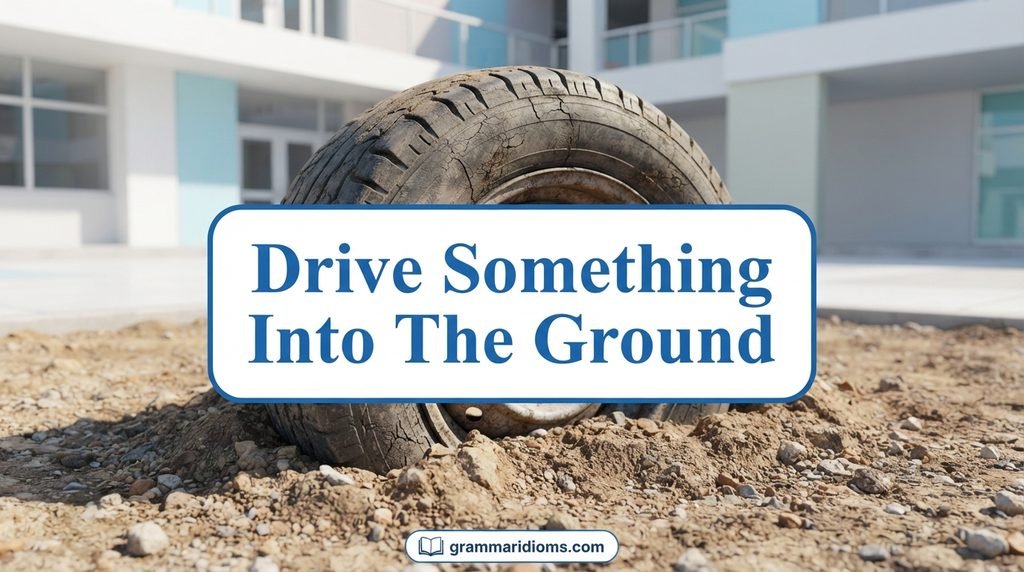
Meaning:
“Drive something into the ground” can mean to destroy something through poor management or excessive use, while “drive someone into the ground” can mean to exhaust someone through excessive demands.
In a Sentence:
“Constantly changing the business plan could drive the small company into the ground.”
Other Ways to Say It:
- Ruin something
- Wear something out
- Destroy something
- Exhaust someone
Explanation:
The image is forceful: something is pushed downward until it is buried or damaged. In figurative English, that physical force becomes a way to describe destruction, exhaustion, or excessive pressure.
The expression can be especially strong when discussing a business, resource, person, or project.
Best Use:
Business writing, serious discussions, journalism, and descriptions of exhaustion or decline.
Tone: Strong, negative, and dramatic.
Common Mistake:
Do not confuse “drive something into the ground” with simply driving a vehicle onto the ground. The figurative expression usually communicates serious damage, failure, or exhaustion.
Pave the Way
Meaning:
“Pave the way” means to make something possible or easier for something else to happen later.
In a Sentence:
“The new road paved the way for businesses to reach the area more easily.”
Other Ways to Say It:
- Make possible
- Prepare the way
- Open the door for
- Create conditions for
Explanation:
The expression comes from the physical idea of building or improving a road so that others can travel along it. Figuratively, it describes an action that creates favorable conditions for future progress.
It works particularly well when one development leads naturally to another.
Best Use:
Essays, reports, journalism, professional writing, speeches, and formal discussions.
Tone: Neutral to formal and strongly figurative.
Common Mistake:
“Pave the way” usually describes preparation or enabling conditions. It does not necessarily mean that the final result has already happened.
Exercise: Practice Using Idioms
Choose the best answer for each question.
1. What does “hit the road” mean?
A. Repair a damaged road
B. Leave or begin a journey
C. Drive into another vehicle
D. Stop beside a road
2. If someone is “in the driving seat,” what does it usually mean?
A. They are sitting in a parked car
B. They are learning to drive
C. They are waiting for a passenger
D. They are in control of a situation
3. What is a backseat driver?
A. Someone who gives unwanted driving advice
B. Somebody who repairs car seats
C. Someone who drives only short distances
D. Someone who sits in the front passenger seat
4. What does “put the pedal to the metal” suggest?
A. Drive carefully
B. Stop immediately
C. Use maximum speed or effort
D. Change a flat tire
5. Which sentence uses “get into gear” correctly in a figurative sense?
A. She got into gear and began organizing the event.
B. She got into gear because the road was wet.
C. He got into gear and parked the car outside.
D. They got into gear after replacing the tires.
6. If a team “shifts gears,” what happens?
A. The team buys a vehicle
B. The team changes its focus or approach
C. The team stops working permanently
D. The team begins driving somewhere
7. What does “put the brakes on” mean figuratively?
A. Speed something up
B. Repair a vehicle
C. Start a new activity
D. Slow down or stop something
8. Which expression means “avoid something potentially troublesome”?
A. Hit the road
B. Drive home
C. Steer clear of
D. Burn rubber
9. If a student is “on the right track,” what does this suggest?
A. The student is physically near a railway
B. The student is making progress in the correct direction
C. The student is driving correctly
D. The student has finished the task
10. What does “at a crossroads” usually suggest?
A. Facing an important decision
B. Driving through heavy traffic
C. Traveling to a remote village
D. Getting lost on a motorway
11. Which expression can describe an exciting but potentially risky lifestyle?
A. Off the beaten track
B. In the driving seat
C. In the fast lane
D. Put the brakes on
12. If something “drives you up the wall,” how do you feel?
A. Relaxed
B. Extremely annoyed
C. Proud
D. Confused about directions
13. What does it mean to “drive a hard bargain”?
A. Negotiate firmly for favorable terms
B. Drive a car on a difficult road
C. Refuse to travel
D. Avoid making a purchase
14. Which expression means to damage a relationship between people?
A. Drive something home
B. Get into gear
C. Pave the way
D. Drive a wedge between
15. What does “drive a message home” mean?
A. Deliver a message by car
B. Repeat or emphasize a point strongly
C. Take a message to someone’s house
D. Change the subject quickly
Answers
- B — “Hit the road” means to leave or begin a journey. It is an informal expression often used when someone is ready to depart.
- D — Being “in the driving seat” means being in control or in charge of a situation.
- A — A backseat driver gives unwanted advice or criticism, especially to someone who is driving.
- C — “Put the pedal to the metal” means to use maximum speed or effort.
- A — “Get into gear” can mean become active, organized, or productive. It does not have to refer to an actual vehicle.
- B — To “shift gears” figuratively means to change focus, approach, activity, or direction.
- D — “Put the brakes on” means to slow down or stop an activity or process.
- C — “Steer clear of” means to avoid someone or something that may cause trouble or danger.
- B — Being “on the right track” means your approach or direction is appropriate and you are making progress.
- A — Being “at a crossroads” means facing an important choice or turning point.
- C — “In the fast lane” can describe a fast-paced, exciting, and sometimes risky lifestyle.
- B — “Drive someone up the wall” means to make them extremely annoyed or angry.
- A — To “drive a hard bargain” means to negotiate firmly and seek favorable terms.
- D — To “drive a wedge between” people means to create division or damage their relationship.
- B — To “drive a message home” means to emphasize an idea strongly enough that people understand it clearly.
FAQs
What are some common idioms for driving?
Common driving idioms include “hit the road,” “in the driving seat,” “backseat driver,” and “put the pedal to the metal.” These English idioms describe leaving, control, interference, speed, and effort.
What does “hit the road” mean?
“Hit the road” means to leave a place or begin a journey. It is a casual driving expression commonly used in everyday English conversations.
What does “in the driving seat” mean?
“In the driving seat” means being in control of a situation or responsible for decisions. It is common in British English, while “in the driver’s seat” is more common in American English.
Which driving idiom means to avoid something?
“Steer clear of” means to avoid someone or something that may cause trouble or danger. It is a useful expression for everyday conversation and practical English.
How can I learn driving idioms effectively?
Learn idiom meanings through examples and real contexts instead of memorizing isolated phrases. Grouping useful idioms by ideas such as speed, control, direction, and risk can also improve your language skills.
Conclusion
Driving idioms make English idioms more vivid by connecting driving, cars, roads, and travel with everyday ideas about control, speed, direction, risk, and progress. By learning these idiomatic expressions through clear idiom examples and natural usage, you can improve your English speaking, practical English, and communication skills. These useful idioms can also make everyday conversations smoother and help you better understand the figurative side of the English language.


