

Cake idioms add color and charm to everyday English conversations. These fun phrases use food imagery to express feelings, situations, and experiences. From piece of cake to icing on the cake, each expression has a figurative meaning beyond its literal meaning. Learning these English idioms can help you understand native speakers and communicate naturally.
Whether you enjoy sweet treats or simply want stronger English vocabulary, these expressions offer practical value. They appear in everyday situations, business situations, and social situations with different meanings. So, learning their idiom meanings, example sentences, and practical usage tips can build confident usage. Along the way, you will discover popular cake idioms that make conversations more colorful and relatable.
What Is an Idiom?
An idiom is a fixed or established expression whose meaning is different from the literal meaning of its individual words.
For example, “break the ice” does not normally mean physically breaking ice. It means to make people feel more comfortable in a social situation. Likewise, “spill the beans” usually means to reveal a secret, not to drop beans on the floor.
Idioms can be confusing for English learners because the literal image often gives little clue about the figurative meaning. Learning the expression as a complete phrase makes its usage much easier to understand.
How Is an Idiom Different From a Metaphor or Simile?
These forms of figurative language are related, but they are not identical.
- Idiom: An established expression with a figurative meaning. “A piece of cake” means something is very easy.
- Metaphor: A direct imaginative comparison. “The cake was a mountain of chocolate” compares the cake to a mountain without using “like” or “as.”
- Simile: A comparison using words such as “like” or “as.” For example, “The frosting was as smooth as silk.”
- Literal expression: Words are used in their ordinary, direct sense. “She cut the cake into eight pieces” is literal.
Not every creative description is an idiom. A writer can invent a fresh metaphor, but an idiom is an established expression recognized and used by speakers of the language.
Why Use Idioms for Cake?
Cake naturally connects with ideas such as reward, pleasure, celebration, difficulty, sharing, and temptation, which makes it a rich source of figurative language.
Idioms can help you:
- Express an idea more vividly than plain language.
- Talk about cake-related experiences with personality.
- Describe something that is unusually easy or unexpectedly good.
- Explain sharing, competition, or business opportunities.
- Add humor to conversations and social posts.
- Understand common expressions used in everyday English.
- Recognize the difference between literal cake imagery and figurative meaning.
For example, saying a decorating job was “a piece of cake” communicates more than simply saying it was easy. The expression creates a familiar, friendly image of something as effortless as eating cake.
Quick List of 20 Idioms
- A Piece of Cake
- The Icing on the Cake
- Have Your Cake and Eat It Too
- Sell Like Hot Cakes
- Take the Cake
- Cakewalk
- A Slice of the Cake
- The Cherry on Top of the Cake
- A Piece of the Pie
- As Easy as Pie
- Pie in the Sky
- Eat Humble Pie
- Have a Finger in Every Pie
- A Pie in the Face
- Have Something on Your Plate
- Give Something to Someone on a Plate
- A Piece of the Action
- Sweeten the Pill
- Born With a Silver Spoon in Your Mouth
- Put All Your Eggs in One Basket
A Piece of Cake
Meaning:
A piece of cake means something is very easy to do. The expression is informal and common in everyday English.
The literal image is simply a piece of dessert. Figuratively, it suggests that a task is so easy that it requires little effort. Cambridge Dictionary lists it as an informal idiom meaning something very easy to do.
In a Sentence:
“Once I understood the decorating technique, making the cupcakes was a piece of cake.”
Other Ways to Say It:
- Very easy
- A breeze
- Simple as anything
- No trouble at all
Explanation:
This is probably the most directly useful cake-related idiom for English learners. It turns an ordinary slice of cake into an image of effortless success.
Tone: Casual and friendly.
Best Use:
Everyday conversation, informal messages, storytelling, and light social writing.
Common Mistake:
Do not use it to mean an actual slice of cake when the surrounding context is clearly figurative.
See Also: 20 Idioms for Fake Friends (With Examples)
The Icing on the Cake
Meaning:
The icing on the cake means an extra good thing that makes an already good situation even better.
Literally, icing completes or decorates a cake. Figuratively, it represents a pleasant final addition. Cambridge Dictionary defines it as something that makes a good situation even better.
In a Sentence:
“The birthday cake looked beautiful, and the handwritten message was the icing on the cake.”
Other Ways to Say It:
- An added bonus
- The finishing touch
- An extra benefit
- The final touch
Explanation:
This expression works especially well when the main experience is already positive. The additional detail does not create the good situation, but it makes it more satisfying.
Tone: Warm and positive.
Best Use:
Conversations, personal writing, reviews, speeches, and descriptions of celebrations.
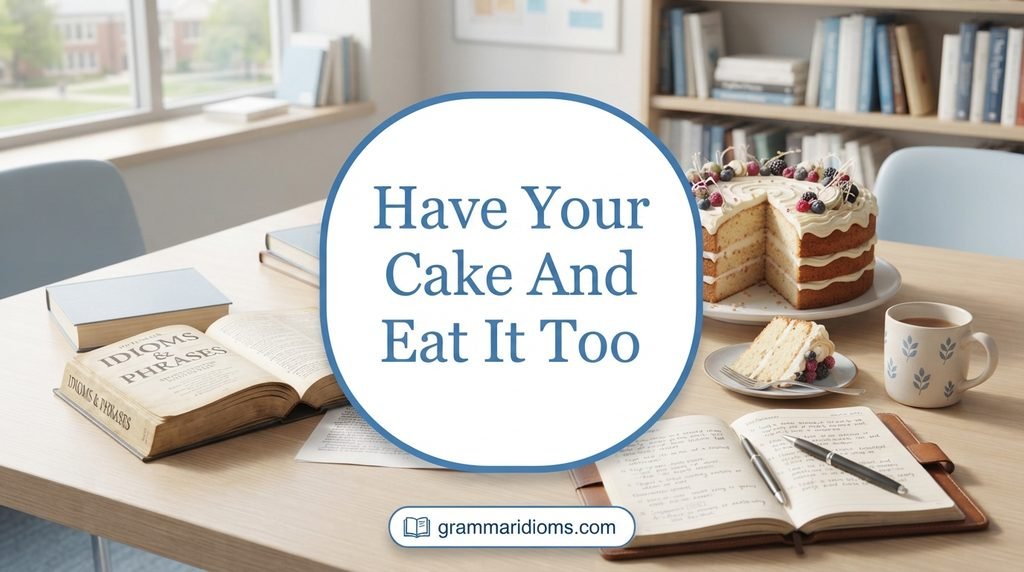
Have Your Cake and Eat It Too
Meaning:
Have your cake and eat it too means wanting or getting two desirable things that normally cannot be enjoyed together.
The image is simple: once you eat the cake, you no longer possess the whole cake. Figuratively, the phrase points to conflicting advantages. Cambridge Dictionary gives this established meaning.
In a Sentence:
“You can’t have your cake and eat it too by demanding a custom cake without allowing enough time for the baker to make it.”
Other Ways to Say It:
- Have the best of both worlds
- Get everything you want
- Have it both ways
- Enjoy two incompatible benefits
Explanation:
This idiom often appears when someone wants maximum benefits without accepting the normal trade-off. It can describe cake orders, budgets, schedules, or everyday choices.
Tone: Conversational and sometimes mildly critical.
Best Use:
Everyday discussion, advice, arguments, and explanatory writing.
Common Mistake:
The expression is normally used figuratively. It is not simply a statement about eating dessert.
Sell Like Hot Cakes
Meaning:
Sell like hot cakes means something is bought quickly and in large numbers.
The expression uses the appealing image of fresh, hot food that people want immediately. Cambridge Dictionary identifies “go/sell like hotcakes” as an informal idiom meaning to be bought quickly and in large numbers.
In a Sentence:
“The bakery’s new strawberry cakes sold like hot cakes during the holiday weekend.”
Other Ways to Say It:
- Sell very quickly
- Be in high demand
- Fly off the shelves
- Be extremely popular
Explanation:
This idiom is especially natural when talking about products. It can describe cakes themselves or a bakery’s wider range of products.
Tone: Informal and energetic.
Best Use:
Business writing with an informal tone, conversations, product descriptions, and storytelling.
Take the Cake
Meaning:
Take the cake means to be especially remarkable, surprising, annoying, or extreme. In American English, it can describe something that stands out as the most notable example of its kind. In British English, “take the biscuit” is commonly used instead.
In a Sentence:
“I’ve seen some unusual birthday cakes, but that three-meter chocolate tower really takes the cake.”
Other Ways to Say It:
- Be the most remarkable
- Go too far
- Be the extreme example
- Stand out from the rest
Explanation:
The phrase can be positive, negative, or simply surprised depending on context. That flexibility makes it useful when something is unusually impressive or outrageous.
Tone: Informal and expressive.
Best Use:
Everyday conversation, humorous writing, storytelling, and informal commentary.
Common Mistake:
Do not assume it always means something is excellent. Context can make it complimentary or critical.
Cakewalk
Meaning:
A cakewalk is something that is very easy to achieve, especially a contest or task expected to require little difficulty. Cambridge Dictionary identifies this modern meaning as informal.
In a Sentence:
“Decorating a simple sponge cake was a cakewalk compared with making the wedding cake.”
Other Ways to Say It:
- An easy job
- A breeze
- Effortless
- Easy victory
Explanation:
The word has a cake-related appearance but is not normally about baking. Its figurative sense describes something requiring very little difficulty.
The word also has a historical meaning connected to a dance that developed among African Americans in the United States. That historical meaning is separate from its modern figurative use.
Tone: Informal.
Best Use:
Conversation, sports or competition writing, casual descriptions, and storytelling.
A Slice of the Cake
Meaning:
A slice of the cake means a share of money or benefits from an activity. Cambridge Dictionary marks this expression as informal Australian English.
In a Sentence:
“After the cake business became profitable, every partner wanted a slice of the cake.”
Other Ways to Say It:
- A share of the profits
- A portion of the benefits
- A piece of the business
- A financial share
Explanation:
The cake becomes a visual representation of something valuable that can be divided. Each person wants a portion of the whole.
Because this usage is marked as Australian English, learners should be aware that it may sound less familiar in other varieties of English.
Tone: Informal and business-related.
Best Use:
Business conversations, discussions about profits, and informal writing.
The Cherry on Top of the Cake

Meaning:
The cherry on top of the cake describes something that makes an already good situation even better or nearly perfect. It is also commonly shortened to “the cherry on top.”
In a Sentence:
“The cake was delicious, and the edible flowers were the cherry on top.”
Other Ways to Say It:
- The finishing touch
- The final bonus
- The perfect addition
- The crowning touch
Explanation:
The expression creates a visual image of a final decorative detail. It is particularly useful when a cake already looks or tastes excellent and one last element completes it.
Tone: Positive, playful, and slightly expressive.
Best Use:
Celebrations, reviews, social media captions, creative writing, and personal messages.
A Piece of the Pie
Meaning:
A piece of the pie means a share of something, especially money, profits, opportunities, or benefits.
In a Sentence:
“Once her custom-cake business became successful, several investors wanted a piece of the pie.”
Other Ways to Say It:
- A share
- A portion
- A stake
- A cut of the profits
Explanation:
Although the expression uses pie rather than cake, it fits naturally into discussions about cake businesses and sharing. The food image makes the idea of dividing a whole into portions easy to picture.
Tone: Informal.
Best Use:
Business conversations, financial discussions, and casual writing.
As Easy as Pie
Meaning:
As easy as pie means very easy. It is similar in meaning to “a piece of cake.” Cambridge Dictionary lists it as an idiom.
In a Sentence:
“Once the layers were cooled, assembling the cake was as easy as pie.”
Other Ways to Say It:
- Very easy
- A breeze
- Effortless
- Simple enough
Explanation:
This is useful when discussing baking because it creates a playful contrast with cake while still communicating ease. It can describe almost any task, not only cooking.
Tone: Casual and lighthearted.
Best Use:
Everyday conversation, informal writing, and humorous descriptions.
Common Mistake:
Do not confuse this expression with “easy as ABC.” Both express ease, but they are separate idioms.
Pie in the Sky
Meaning:
Pie in the sky describes something that is hoped for but very unlikely to happen.
In a Sentence:
“Getting a huge wedding cake for free was a pie-in-the-sky idea.”
Other Ways to Say It:
- An unrealistic hope
- An unlikely dream
- Wishful thinking
- An impractical plan
Explanation:
The image is deliberately impossible: a delicious pie is imagined floating somewhere in the sky, out of reach. The expression works well for unrealistic plans or expectations.
Tone: Informal and sometimes skeptical.
Best Use:
Conversation, commentary, storytelling, and informal writing.
Eat Humble Pie
Meaning:
Eat humble pie means to admit that you were wrong, especially after being confident or boastful. Cambridge Dictionary classifies it as an informal idiom.
In a Sentence:
“After insisting that the cake would never collapse, I had to eat humble pie when the middle sank.”
Other Ways to Say It:
- Admit you were wrong
- Own your mistake
- Swallow your pride
- Apologize and admit fault
Explanation:
The phrase turns admitting an error into the humorous image of eating an unpleasant dish. It is particularly effective when someone has confidently made a prediction that proved incorrect.
Tone: Informal and mildly humorous.
Best Use:
Conversation, storytelling, opinion writing, and lighthearted personal messages.
Common Mistake:
It does not mean eating a modest or inexpensive pie.
Have a Finger in Every Pie
Meaning:
Have a finger in every pie means to be involved in many different activities or situations, often in a way others may find intrusive.
In a Sentence:
“Our bakery owner has a finger in every pie, from designing cakes to managing deliveries.”
Other Ways to Say It:
- Be involved in everything
- Have many interests
- Meddle in many matters
- Be involved in many projects
Explanation:
The literal image is someone reaching into many pies. Figuratively, it suggests a person who wants involvement or influence in numerous activities.
The expression can be positive when describing someone energetic and involved, but it often carries a slightly critical suggestion of interference.
Tone: Informal.
Best Use:
Conversation, storytelling, workplace discussions, and descriptions of busy people.
A Pie in the Face
Meaning:
A pie in the face can refer literally to the classic comic act of throwing a pie at someone’s face. Figuratively, it can describe an insult, rebuff, or humiliating response. Cambridge Dictionary records both uses.
In a Sentence:
“After boasting about his perfect cake design, the failed decoration felt like a pie in the face.”
Other Ways to Say It:
- An embarrassing setback
- A public rebuff
- A humiliation
- A sharp put-down
Explanation:
This expression carries strong comic imagery. It works particularly well when a confident claim or expectation is followed by an embarrassing result.
Tone: Humorous, dramatic, and informal.
Best Use:
Comedy, storytelling, informal commentary, and playful writing.
Have Something on Your Plate
Meaning:
Have something on your plate means to have a lot of work, responsibilities, or important things to deal with.
In a Sentence:
“I already have three birthday cakes to finish, so I have a lot on my plate this weekend.”
Other Ways to Say It:
- Be very busy
- Have a lot to handle
- Have a full schedule
- Have your hands full
Explanation:
The expression turns a plate into a picture of responsibilities piling up. It works especially naturally in cake and food contexts because a literal plate may already be part of the scene.
Tone: Casual and conversational.
Best Use:
Everyday conversation, workplace messages, planning discussions, and personal writing.
Give Something to Someone on a Plate

Meaning:
Give or hand something to someone on a plate means to allow someone to get or win something very easily, without having to work hard for it.
In a Sentence:
“The bakery didn’t hand the award to us on a plate; we spent months improving our recipes.”
Other Ways to Say It:
- Make something very easy for someone
- Hand someone an opportunity
- Give someone an easy advantage
- Make success effortless
Explanation:
The expression creates an image of placing a desired prize directly on a plate and presenting it. It is useful when emphasizing that someone received an advantage with little effort.
Tone: Informal.
Best Use:
Conversation, sports commentary, storytelling, and informal discussions about success.
A Piece of the Action
Meaning:
A piece of the action means a share in the profits, advantages, or excitement connected with an activity.
In a Sentence:
“When the bakery’s custom-cake service became popular, local suppliers wanted a piece of the action.”
Other Ways to Say It:
- A share of the profits
- A part of the success
- A stake in the activity
- A chance to participate
Explanation:
This idiom is useful when talking about the business side of cake. It focuses less on the physical dessert and more on the opportunity surrounding it.
Tone: Informal.
Best Use:
Business conversations, storytelling, entertainment writing, and casual commentary.
Sweeten the Pill
Meaning:
Sweeten the pill means to make something unpleasant or difficult seem easier to accept by adding something positive. Cambridge Dictionary lists this as an idiom and notes that the UK equivalent is “sugar the pill.”
In a Sentence:
“The bakery increased its delivery fee but sweetened the pill by offering free birthday candles.”
Other Ways to Say It:
- Make something more acceptable
- Ease the disappointment
- Add a positive incentive
- Make bad news easier to accept
Explanation:
The expression uses sweetness as a metaphor for making something unpleasant easier to swallow. It can fit cake-related business situations particularly well because cake naturally suggests sweetness.
Tone: Informal to neutral.
Best Use:
Business communication, explanations, negotiations, and everyday conversation.
Common Mistake:
The phrase does not mean making actual medicine taste sweeter.
Born With a Silver Spoon in Your Mouth
Meaning:
Born with a silver spoon in your mouth means being born into wealth or a high social position.
In a Sentence:
“She grew up surrounded by luxury and was born with a silver spoon in her mouth, including elaborate cakes at every celebration.”
Other Ways to Say It:
- Born into wealth
- Born into privilege
- Come from a wealthy family
- Grow up with advantages
Explanation:
The expression uses a valuable spoon as a symbol of wealth available from birth. It can connect naturally with expensive celebrations, luxury desserts, or lavish cake traditions.
Tone: Informal and often critical or observational.
Best Use:
Storytelling, social commentary, conversations about privilege, and descriptive writing.
Common Mistake:
It describes family circumstances at birth, not someone who became wealthy through their own work.
Put All Your Eggs in One Basket

Meaning:
Put all your eggs in one basket means to depend too heavily on one person, plan, opportunity, or source of success.
In a Sentence:
“A new cake shop shouldn’t put all its eggs in one basket by relying on only wedding orders.”
Other Ways to Say It:
- Depend on one option
- Risk everything on one plan
- Put all your hopes in one place
- Fail to diversify
Explanation:
Although this idiom is not about cake, it is highly useful when discussing a bakery or cake business. The fragile eggs create a memorable image of what can happen when all your resources depend on one choice.
Tone: Practical and conversational.
Best Use:
Business advice, planning, education, and everyday discussion.
Exercise: Practice Using Idioms
Choose the answer that best explains the expression or fits the context.
Question 1
If someone says, “The cake decorating class was a piece of cake,” what do they mean?
A. The class included free cake.
B. The class was very easy.
C. The class lasted only one hour.
D. The class was about baking.
Question 2
Which expression describes an extra benefit that makes an already good situation even better?
A. Eat humble pie
B. Pie in the sky
C. Have something on your plate
D. The icing on the cake
Question 3
A bakery’s new cupcakes are selling extremely quickly. Which expression fits best?
A. They are selling like hot cakes.
B. They are eating humble pie.
C. They are on a plate.
D. They are pie in the sky.
Question 4
Someone wants both advantages of two choices even though the choices are incompatible. Which idiom applies?
A. Take the cake
B. Cakewalk
C. Have your cake and eat it too
D. A piece of the action
Question 5
What does “take the cake” usually mean in informal American English?
A. To receive a dessert
B. To be especially remarkable, surprising, annoying, or extreme
C. To win a baking lesson
D. To divide a cake fairly
Question 6
Which sentence uses “eat humble pie” correctly?
A. I ate humble pie because I was hungry after dinner.
B. The bakery served humble pie at the wedding.
C. She decorated the humble pie with roses.
D. After saying the recipe could not fail, he had to eat humble pie when it went wrong.
Question 7
What does “pie in the sky” suggest?
A. A realistic cooking plan
B. An ordinary dessert
C. An unlikely hope or unrealistic idea
D. A successful bakery
Question 8
If a bakery owner “has a finger in every pie,” what does that suggest?
A. The owner is involved in many activities.
B. The owner only sells pies.
C. The owner dislikes cake.
D. The owner is preparing one specific dessert.
Question 9
Which expression means having a large amount of work or responsibility to deal with?
A. Take the cake
B. Have something on your plate
C. Sell like hot cakes
D. A slice of the cake
Question 10
A person receives an opportunity without having to work for it. Which expression fits?
A. Eat humble pie
B. Pie in the sky
C. Give something to someone on a plate
D. Put all your eggs in one basket
Question 11
Which expression refers to receiving a share of money or benefits from an activity?
A. A piece of the pie
B. Cakewalk
C. The icing on the cake
D. Sweeten the pill
Question 12
Which expression is best for someone who admits they were wrong after making a confident claim?
A. Sell like hot cakes
B. Have a finger in every pie
C. The cherry on top
D. Eat humble pie
Question 13
Which sentence uses “put all your eggs in one basket” naturally?
A. I put all my eggs in one basket because I like breakfast.
B. The baker put eggs in a basket before making the cake.
C. The shop should not rely entirely on one customer; that would put all its eggs in one basket.
D. The cake was decorated with eggs in a basket.
Question 14
Which statement correctly distinguishes an idiom from a metaphor?
A. Every metaphor is automatically an idiom.
B. An idiom is an established expression with a figurative meaning, while a metaphor can be a creative comparison.
C. Idioms must always contain food words.
D. Metaphors always have literal meanings.
Question 15
Which expression is especially useful when talking about something that makes an already successful cake business even better?
A. The cherry on top of the cake
B. Pie in the sky
C. Eat humble pie
D. Put all your eggs in one basket
Answers
- B — “A piece of cake” means something is very easy to do.
- D — “The icing on the cake” describes an extra positive feature added to something already good.
- A — “Sell like hot cakes” means to be bought quickly and in large numbers.
- C — “Have your cake and eat it too” refers to wanting two benefits that normally cannot both be obtained.
- B — “Take the cake” can describe something especially surprising, annoying, extreme, or remarkable.
- D — “Eat humble pie” means admitting that you were wrong, especially after being confident about something.
- C — “Pie in the sky” refers to an unlikely hope or unrealistic expectation.
- A — “Have a finger in every pie” means being involved in many activities or matters.
- B — “Have something on your plate” means having a lot of work or responsibility.
- C — “Give something to someone on a plate” means making it very easy for someone to obtain or win something.
- A — “A piece of the pie” means a share of something, often money, profits, or benefits.
- D — “Eat humble pie” is used when someone admits they were wrong.
- C — “Put all your eggs in one basket” means depending too heavily on one plan, person, or opportunity.
- B — An idiom is an established figurative expression, while a metaphor can be newly created by a speaker or writer.
- A — “The cherry on top of the cake” means a final addition that makes something already good even better.
FAQs
What is an idiom for cake?
The most direct cake idioms include “a piece of cake,” “the icing on the cake,” and “take the cake.” These English idioms use cake to express ideas such as ease, extra benefits, or something remarkable.
What does “a piece of cake” mean?
“A piece of cake” means something is very easy to do. It is a common expression for everyday situations and casual conversations.
What does “the icing on the cake” mean?
“The icing on the cake” describes something that makes an already good situation even better. The phrase uses food imagery to create a clear figurative meaning.
Are cake idioms used in everyday English?
Yes, many popular cake idioms appear in everyday language, social situations, and informal conversations. Learning their idiom meanings can help improve your English vocabulary and language skills.
How can I learn cake-related idioms easily?
Learn each cake-related idiom with its meaning, example sentence, and common usage. Then practice these figurative expressions in realistic everyday situations to build more confident usage.
Conclusion
Cake idioms make English vocabulary more vivid, helping you express ease, success, sharing, mistakes, and everyday situations with natural figurative expressions. By learning popular cake idioms such as a piece of cake, the icing on the cake, and eat humble pie, you can add variety and confidence to everyday conversations.


