
Environment phrasal verbs help English learners talk about climate change, pollution, and environmental protection with confidence. Many people rely on them in everyday English, environmental news, and workplace communication. For example, leaders call for change, and companies phase out harmful products. Likewise, workers chop down trees, and throwaway culture makes people use up natural resources. These environmental expressions also appear in spoken English and written reports.
Below, you will find clear phrasal verb meanings, grammar notes, and practical examples to build your environmental vocabulary. Each example sentence shows contextual usage, so you can reduce waste and protect the planet in your own words. As a result, you can join environmental discussions and push for renewable energy with ease. Teachers can also use these English expressions for classroom discussion and student practice.
What Is a Phrasal Verb?
A phrasal verb is a combination of a main verb and one or more particles that work together to create a particular meaning.
A particle is usually an adverb or preposition. Common particles include up, down, out, off, on, in, away, back, and over.
A regular verb usually expresses an action directly. However, adding a particle can change its meaning.
Consider these examples:
- Give up: To stop trying or doing something.
- Look after: To take care of someone or something.
- Find out: To discover information.
- Put off: To postpone something.
The individual words do not always explain the complete meaning of a phrasal verb. For example, give up does not mean physically giving something upward. It means stopping an activity or accepting that something cannot be achieved.
Phrasal verbs can have literal or idiomatic meanings. Some are easy to understand from their individual words, while others have meanings that must be learned separately.
They are important because people use them frequently in natural conversations, informal writing, and everyday communication.
What Are the Most Useful Phrasal Verbs for Environment?
Some of the most useful environmental phrasal verbs include clean up, cut down on, give off, break down, phase out, throw away, use up, run out of, dry up, wash away, die out, wipe out, put out, soak up, and turn off.
These expressions describe different environmental activities and problems. For example, clean up describes removing pollution, cut down on means reducing consumption, and give off refers to releasing substances such as gases or heat.
Choosing the correct expression depends on the situation. Some phrasal verbs describe environmental protection, while others explain pollution, resource depletion, habitat destruction, and natural changes.
Quick Reference Table of Environmental Phrasal Verbs
| Phrasal Verb | Simple Meaning | Example |
| Clean up | Remove dirt or pollution | Volunteers cleaned up the beach. |
| Cut down on | Reduce consumption | We should cut down on plastic. |
| Give off | Release gas, heat, or smell | Factories give off harmful gases. |
| Break down | Decompose naturally | Organic waste breaks down over time. |
| Phase out | Gradually stop using something | The country will phase out coal. |
| Throw away | Dispose of something | Do not throw away recyclable bottles. |
| Use up | Consume completely | We must not use up natural resources. |
| Run out of | Have none left | Some communities may run out of water. |
| Dry up | Become dry or lose water | The small lake dried up. |
| Wash away | Remove through flowing water | Heavy rain washed away the soil. |
| Die out | Become extinct or disappear | Some animal species may die out. |
| Wipe out | Destroy completely | Pollution can wipe out local wildlife. |
| Put out | Extinguish a fire | Firefighters put out the forest fire. |
| Soak up | Absorb liquid or another substance | Trees help soak up rainwater. |
| Turn off | Stop the flow of electricity or a device | Turn off unnecessary lights. |
Common Phrasal Verbs With Environment
The following phrasal verbs help explain environmental activities, conservation efforts, pollution, and natural changes. Each expression includes its meaning, grammatical pattern, and practical examples.
1. Clean Up
Meaning:
Clean up means to remove dirt, rubbish, pollution, or unwanted materials from a place.
How It Is Used:
This phrasal verb is commonly used when discussing environmental protection and community activities. People use it when describing beach cleanups, polluted rivers, public parks, and contaminated areas.
It can also describe improving an unpleasant or untidy situation.
Grammar Pattern:
- Subject + clean up + object.
- Subject + clean + object + up.
Example Sentences:
- Example 1: Local volunteers cleaned up the riverbank last weekend.
- Example 2: The government plans to clean up the polluted industrial area.
- Example 3: Residents worked together to clean up their neighborhood.
Important Usage Note:
Clean up is separable when it takes an object.
Both sentences are correct:
- Volunteers cleaned up the beach.
- Volunteers cleaned the beach up.
With a pronoun, place it between the verb and particle:
- Volunteers cleaned it up.
2. Cut Down On
Meaning:
Cut down on means to reduce the amount of something that you use, consume, or produce.
How It Is Used:
This expression is particularly useful when discussing environmental responsibility. People use it when talking about reducing plastic consumption, saving electricity, limiting water use, and lowering waste production.
It is common in everyday conversations and environmental advice.
Grammar Pattern:
- Subject + cut down on + noun.
- Subject + cut down on + gerund.
Example Sentences:
- Example 1: Families should cut down on single-use plastic.
- Example 2: Our company is trying to cut down on unnecessary packaging.
- Example 3: I have started cutting down on water consumption at home.
Important Usage Note:
Do not confuse cut down on with cut down.
- Cut down on: Reduce the amount of something.
- Cut down: Fell a tree or reduce something, depending on context.
For example, cut down on paper use means using less paper, while cut down a tree means felling it.
3. Give Off
Meaning:
Give off means to release or produce something such as gas, heat, light, or an unpleasant smell.
How It Is Used:
This expression is useful when discussing pollution, industrial emissions, greenhouse gases, and chemical substances.
Factories, vehicles, burning materials, and certain natural processes can give off gases or other substances.
Grammar Pattern:
- Subject + give off + object.
Example Sentences:
- Example 1: Some factories give off harmful gases during production.
- Example 2: Burning plastic can give off toxic fumes.
- Example 3: Certain household appliances give off heat while operating.
Important Usage Note:
Give off is a separable phrasal verb. Its object can appear before or after off.
For example:
- The machine gives off heat.
- The machine gives the heat off.
The first sentence is generally more natural. With pronouns, use the middle position: The machine gives it off.
4. Break Down
Meaning:
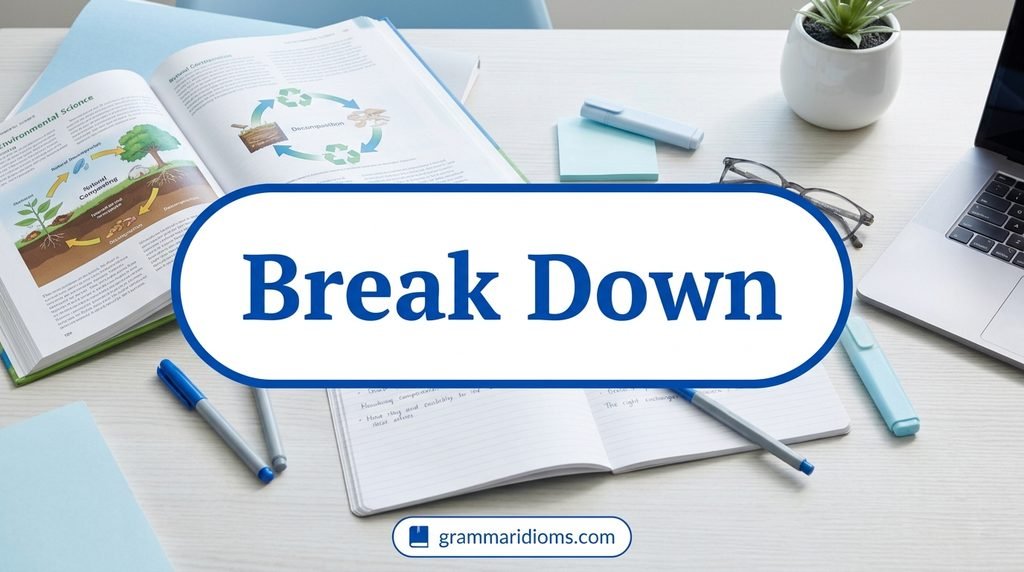
Break down means to separate into smaller parts through a natural or chemical process.
How It Is Used:
This phrasal verb is especially useful when discussing biodegradable materials, composting, and waste management.
For example, food scraps and leaves can break down naturally over time. However, some plastics take much longer to decompose.
It also has other meanings, including a machine stopping working or a person losing emotional control.
Grammar Pattern:
- Subject + break down.
- Subject + break down + object.
Example Sentences:
- Example 1: Fallen leaves break down and add nutrients to the soil.
- Example 2: Some biodegradable packaging can break down under suitable conditions.
- Example 3: Microorganisms help break down organic waste in compost.
Important Usage Note:
When something decomposes naturally, break down is generally intransitive.
When something causes another material to decompose, it can be transitive and separable.
For example:
- Organic waste breaks down naturally.
- Microorganisms break organic waste down.
5. Phase Out
Meaning:
Phase out means to gradually stop using, producing, or providing something.
How It Is Used:
This expression frequently appears in environmental policies, business discussions, and government announcements.
It is useful when talking about replacing harmful products, reducing fossil fuel dependence, and introducing cleaner technologies.
Unlike stop, it suggests a gradual process rather than an immediate change.
Grammar Pattern:
- Subject + phase out + object.
- Subject + phase + object + out.
Example Sentences:
- Example 1: The government plans to phase out certain harmful chemicals.
- Example 2: Several companies are phasing out unnecessary plastic packaging.
- Example 3: The factory will phase out its older coal-powered equipment.
Important Usage Note:
Phase out is separable.
Both forms are correct:
- The company phased out the product.
- The company phased the product out.
With a pronoun, use phase it out.
6. Throw Away
Meaning:
Throw away means to get rid of something that is no longer wanted or needed.
How It Is Used:
This phrasal verb is common in conversations about household waste, recycling, food waste, and environmental responsibility.
People use it when discussing disposable products, unwanted packaging, and items that could be reused or recycled.
Grammar Pattern:
- Subject + throw away + object.
- Subject + throw + object + away.
Example Sentences:
- Example 1: People should not throw away plastic bottles unnecessarily.
- Example 2: She decided to throw away the damaged batteries safely.
- Example 3: Before you throw old clothes away, consider donating them.
Important Usage Note:
Throw away is separable.
When using a pronoun, place it between the verb and particle.
Correct: Please throw it away.
Incorrect: Please throw away it.
Also, throwing something away does not automatically mean recycling it. It simply means getting rid of it.
7. Use Up
Meaning:
Use up means to consume or exhaust the entire amount of something.
How It Is Used:
This phrasal verb is useful when discussing limited natural resources, energy consumption, water supplies, and environmental sustainability.
It highlights the idea that something becomes completely used rather than simply reduced.
Grammar Pattern:
- Subject + use up + object.
- Subject + use + object + up.
Example Sentences:
- Example 1: Excessive consumption could use up valuable natural resources.
- Example 2: The factory has used up most of its water supply.
- Example 3: We should avoid using up resources that future generations may need.
Important Usage Note:
Use up is separable.
For example:
- We used up the available water.
- We used the available water up.
- We used it up.
The expression is stronger than use because it emphasizes complete consumption.
8. Run Out Of
Meaning:
Run out of means to have no supply of something left.
How It Is Used:
This expression is useful when discussing shortages of drinking water, fuel, food, energy, and other important resources.
It often describes a situation in which available supplies are becoming insufficient.
Grammar Pattern:
- Subject + run out of + noun.
Example Sentences:
- Example 1: Some dry regions could run out of drinking water.
- Example 2: The community nearly ran out of clean water during the drought.
- Example 3: If consumption continues to increase, we may run out of certain natural resources.
Important Usage Note:
Run out of is an inseparable phrasal-prepositional verb.
The noun or pronoun follows of.
Correct: We ran out of it.
Incorrect: We ran it out of.
Do not confuse it with run out, which can mean to leave a place quickly or to reach the end of a period.
9. Dry Up
Meaning:
Dry up means to lose moisture or become completely dry.
It can also describe a water source gradually losing its supply.
How It Is Used:
This expression is useful when discussing droughts, climate change, disappearing lakes, rivers, and declining water supplies.
It can describe natural water sources as well as wet soil and other materials.
Grammar Pattern:
- Subject + dry up.
- Subject + dry up + object.
Example Sentences:
- Example 1: The small lake may dry up during a prolonged drought.
- Example 2: Several streams dried up after months without rain.
- Example 3: Rising temperatures can cause shallow wetlands to dry up.
Important Usage Note:
When a lake or river loses its water naturally, dry up is intransitive.
It can also be transitive when something causes another thing to become dry.
For example:
- The drought dried up the pond.
10. Wash Away
Meaning:
Wash away means to remove or carry something away through flowing water.
How It Is Used:
This expression is common in discussions about floods, heavy rainfall, soil erosion, and environmental damage.
It can describe water carrying away soil, seeds, waste, or other materials.
Grammar Pattern:
- Subject + wash away + object.
- Subject + wash + object + away.
Example Sentences:
- Example 1: Heavy rainfall can wash away fertile topsoil.
- Example 2: Floodwater washed away several small plants.
- Example 3: Planting trees can help prevent rain from washing away exposed soil.
Important Usage Note:
Wash away is separable.
For example:
- Rain washed away the soil.
- Rain washed the soil away.
- Rain washed it away.
It is particularly useful when explaining water-related erosion.
11. Die Out
Meaning:
Die out means to disappear completely or gradually stop existing.
How It Is Used:
This phrasal verb is useful when discussing endangered species, biodiversity, wildlife protection, and habitat destruction.
It describes the disappearance of a species or population over time.
Grammar Pattern:
- Subject + die out.
Example Sentences:
- Example 1: Some rare animal species could die out without proper protection.
- Example 2: Scientists are studying why certain insects are beginning to die out.
- Example 3: Habitat destruction can cause local wildlife populations to die out.
Important Usage Note:
Die out is intransitive. It does not take a direct object.
Do not confuse it with wipe out. A species can die out, but an environmental threat can wipe out a species.
12. Wipe Out
Meaning:
Wipe out means to destroy something completely or eliminate it entirely.
How It Is Used:
This expression is useful when discussing serious environmental damage, extinction, pollution, and the destruction of natural habitats.
It often describes severe consequences rather than small environmental changes.
Grammar Pattern:
- Subject + wipe out + object.
- Subject + wipe + object + out.
Example Sentences:
- Example 1: A severe disease could wipe out an entire wildlife population.
- Example 2: Large-scale deforestation can wipe out important natural habitats.
- Example 3: The chemical spill threatened to wipe out fish populations in the affected area.
Important Usage Note:
Wipe out is separable.
For example:
- The disaster wiped out the forest.
- The disaster wiped the forest out.
- The disaster wiped it out.
It is stronger than damage because it suggests complete or near-complete destruction.
13. Put Out
Meaning:
Put out means to extinguish a fire or stop it from burning.
How It Is Used:
This expression is useful when discussing forest fires, wildfires, fire prevention, and environmental emergencies.
It describes the action of controlling or extinguishing a fire.
Grammar Pattern:
- Subject + put out + object.
- Subject + put + object + out.
Example Sentences:
- Example 1: Firefighters worked throughout the night to put out the forest fire.
- Example 2: Heavy rainfall helped put out the smaller fires.
- Example 3: Local teams quickly put out the fire before it spread.
Important Usage Note:
Put out has several meanings. Depending on context, it can also mean to release something, such as a statement or product.
In environmental discussions, it often refers to extinguishing fires.
It is separable:
- They put out the fire.
- They put the fire out.
- They put it out.
14. Soak Up
Meaning:
Soak up means to absorb a liquid or another substance.
How It Is Used:
This phrasal verb is useful when discussing soil, plants, rainwater, oil spills, and environmental absorption.
For example, soil can soak up rainwater, while certain materials can absorb spilled oil.
It can also describe absorbing information or enjoying an experience.
Grammar Pattern:
- Subject + soak up + object.
- Subject + soak + object + up.
Example Sentences:
- Example 1: Healthy soil can soak up rainwater more effectively.
- Example 2: Some plants soak up water through their roots.
- Example 3: Special materials are used to soak up oil after certain spills.
Important Usage Note:
Soak up is separable.
For example:
- The soil soaked up the rainwater.
- The soil soaked the rainwater up.
- The soil soaked it up.
Do not assume that all environmental materials absorb pollutants safely. Their effects depend on the material and substance involved.
15. Turn Off
Meaning:
Turn off means to stop a device, machine, or supply from operating.
How It Is Used:
This expression is commonly used when discussing energy conservation and responsible electricity consumption.
People use it when talking about switching off lights, electrical equipment, and appliances that are not needed.
Grammar Pattern:
- Subject + turn off + object.
- Subject + turn + object + off.
Example Sentences:
- Example 1: Please turn off the lights when leaving the room.
- Example 2: We should turn off unused electrical appliances.
- Example 3: She always turns off her computer before leaving work.
Important Usage Note:
Turn off is separable when it means switching off a device.
For example:
- Turn off the television.
- Turn the television off.
- Turn it off.
The pronoun must appear between turn and off.
Environmental Phrasal Verbs Used in Different Situations
Environmental discussions cover many subjects. Some expressions describe individual habits, while others explain large-scale environmental changes.
Understanding the context makes it easier to choose the right phrasal verb.
Phrasal Verbs for Reducing Pollution
Several expressions describe actions that help reduce pollution and waste.
| Phrasal Verb | Environmental Use | Example |
| Cut down on | Reduce harmful consumption | We should cut down on plastic bags. |
| Clean up | Remove existing pollution | Volunteers cleaned up the river. |
| Phase out | Gradually stop harmful practices | The company will phase out certain chemicals. |
| Turn off | Reduce unnecessary electricity use | Turn off unused appliances. |
| Throw away | Dispose of unwanted materials | Never throw away batteries carelessly. |
These expressions are particularly useful when discussing environmental responsibility at home, school, and work.
Phrasal Verbs for Natural Resources
Natural resources include water, forests, minerals, and energy sources. The following expressions help explain how these resources are used or lost.
| Phrasal Verb | Environmental Use | Example |
| Use up | Consume completely | We must not use up all available resources. |
| Run out of | Have no supply remaining | The village may run out of water. |
| Dry up | Lose water or moisture | The river dried up during the drought. |
| Soak up | Absorb water or another substance | The soil soaked up the rain. |
These expressions help learners describe resource shortages and conservation concerns.
Phrasal Verbs for Wildlife and Habitat Protection
Wildlife and natural habitats face different environmental threats. These expressions help explain those challenges.
| Phrasal Verb | Environmental Use | Example |
| Die out | Disappear completely | Some rare species may die out. |
| Wipe out | Destroy an entire population or habitat | The disease wiped out the local population. |
| Clean up | Remove pollution from habitats | Volunteers cleaned up the nesting area. |
| Break down | Decompose natural materials | Fallen branches break down naturally. |
These expressions are useful in conversations about biodiversity, endangered animals, and habitat conservation.
Phrasal Verbs With Similar Meanings
Some environmental phrasal verbs have related meanings. However, they are not always interchangeable.
Understanding their differences helps you communicate more accurately.
| Phrasal Verbs | Meaning | Important Difference | Example |
| Cut down on / Use up | Relate to resource consumption | Cut down on means reduce use; use up means consume completely. | We should cut down on water use before supplies run out. |
| Die out / Wipe out | Relate to disappearance | Die out is intransitive; wipe out takes an object and emphasizes destruction. | The species died out. Pollution wiped out its habitat. |
| Clean up / Throw away | Relate to waste | Clean up means remove dirt or unwanted materials from an area; throw away means discard something. | We cleaned up the park and threw away the rubbish. |
| Break down / Wash away | Relate to environmental processes | Break down means decompose; wash away means carry something off with water. | Organic matter breaks down, while floods wash away soil. |
| Phase out / Turn off | Relate to stopping something | Phase out means gradually discontinue; turn off means stop a device or supply. | The factory will phase out old equipment and turn off unused machines. |
Cut Down On vs. Use Up
These expressions are useful when discussing resource conservation.
- Cut down on: Reduce how much you consume.
- Use up: Consume the entire available amount.
Example:
We should cut down on electricity use before we use up the available energy resources.
Die Out vs. Wipe Out
Both expressions describe disappearance, but their grammatical patterns differ.
- Die out: A species or population disappears.
- Wipe out: Something destroys a species or population.
Example:
Without conservation efforts, some animals may die out. A serious disease could wipe out an entire population.
Phrasal Verbs vs. Single-Word Environmental Verbs
Phrasal verbs often have shorter, more conversational alternatives. Both forms can be correct, but their tone and natural usage may differ.
| Phrasal Verb | Single-Word Alternative | Meaning |
| Clean up | Clean | Remove dirt or pollution |
| Cut down on | Reduce | Use or consume less |
| Give off | Emit | Release gases, heat, or substances |
| Break down | Decompose | Separate into simpler substances |
| Phase out | Discontinue | Gradually stop using something |
| Throw away | Discard | Get rid of something |
| Use up | Exhaust | Consume the entire supply |
| Dry up | Desiccate | Become extremely dry |
| Wash away | Erode or remove | Carry something away with water |
| Wipe out | Eliminate | Destroy or remove completely |
When Should You Use Phrasal Verbs?
Phrasal verbs are especially natural in everyday conversations.
For example:
- Conversational: Factories give off harmful gases.
- More technical: Factories emit harmful gases.
The second version may be more suitable for scientific reports.
When Should You Use Single-Word Verbs?
Single-word alternatives are often useful in formal, academic, and scientific writing.
For example:
- Conversational: Some materials break down naturally.
- Scientific: Some materials decompose naturally.
Neither form is automatically better. Choose the expression that suits your audience and communication purpose.
How to Use Environmental Phrasal Verbs Correctly
Understanding a phrasal verb’s meaning is only the first step. You must also learn its grammatical pattern and object placement.
Some phrasal verbs are separable, while others must remain together.
1. Separable and Inseparable Phrasal Verbs
A separable phrasal verb allows its object to appear between the main verb and particle or after the complete expression.
For example:
- Volunteers cleaned up the beach.
- Volunteers cleaned the beach up.
Both sentences are correct.
However, when the object is a pronoun, it must appear between the verb and particle.
- Volunteers cleaned it up.
Other separable examples include:
| Phrasal Verb | Correct Object Placement |
| Throw away | Throw away the bottle / Throw the bottle away |
| Turn off | Turn off the lights / Turn the lights off |
| Use up | Use up the water / Use the water up |
| Wipe out | Wipe out the population / Wipe the population out |
| Put out | Put out the fire / Put the fire out |
An inseparable phrasal-prepositional verb does not allow its object to move between the verb and its particles.
For example:
- Correct: The village ran out of water.
- Incorrect: The village ran water out of.
Always learn the grammatical pattern alongside the meaning.
2. Transitive and Intransitive Phrasal Verbs
Phrasal verbs can also be classified according to whether they require an object.
Transitive phrasal verbs take a direct object.
Examples:
- The factory gives off harmful gases.
- Volunteers cleaned up the park.
- Firefighters put out the fire.
- The community threw away the rubbish.
Intransitive phrasal verbs do not require a direct object.
Examples:
- The lake dried up.
- Organic materials break down.
- Some animal species may die out.
A phrasal verb can sometimes have both transitive and intransitive uses.
For example:
- The leaves broke down naturally.
- Microorganisms broke down the organic material.
The first sentence is intransitive, while the second is transitive.
3. Using Phrasal Verbs in Different Tenses
The main verb changes according to the tense. The particle usually stays the same.
Consider the verb clean up:
| Verb Form | Example |
| Base form | Clean up |
| Past form | Cleaned up |
| Past participle | Cleaned up |
| Present participle | Cleaning up |
Examples:
- Present: Volunteers clean up the beach every month.
- Past: Volunteers cleaned up the beach yesterday.
- Present perfect: They have cleaned up several polluted areas.
- Future: The organization will clean up the riverbank.
- Continuous: Workers are cleaning up the affected area.
Another example is give off:
| Verb Form | Example |
| Base form | Give off |
| Past form | Gave off |
| Past participle | Given off |
| Present participle | Giving off |
Example sentences:
- The machine gives off heat.
- The machine gave off a strange smell.
- The equipment has given off excessive heat.
- The equipment is giving off harmful fumes.
Learning the correct verb forms makes your sentences more accurate.
4. Making Negative Sentences and Questions
Phrasal verbs follow ordinary English sentence patterns.
Positive sentence:
Factories give off harmful gases.
Negative sentence:
Factories do not give off harmful gases during this process.
Question:
Do factories give off harmful gases?
For past-tense questions, use did with the base form of the main verb.
- Correct: Did the lake dry up last summer?
- Incorrect: Did the lake dried up last summer?
The same rule applies to other environmental phrasal verbs.
5. Understanding Particles
Particles such as up, down, off, and out can change a verb’s meaning.
However, they do not always have one fixed meaning.
| Particle | Example | Meaning |
| Up | Clean up | Remove dirt or pollution |
| Down | Cut down on | Reduce consumption |
| Off | Give off | Release a substance |
| Out | Run out of | Have no supply remaining |
| Away | Throw away | Discard something |
| Down | Break down | Decompose or separate into smaller parts |
Do not try to understand every phrasal verb by translating its individual words. Learn the complete expression in context.
Common Mistakes When Using Environmental Phrasal Verbs
English learners sometimes understand a phrasal verb’s meaning but use the wrong grammatical structure.
Here are several mistakes worth avoiding.
Mistake 1: Incorrect Pronoun Placement
Incorrect: Please throw away it.
Correct: Please throw it away.
Explanation: Throw away is separable. When using a pronoun, place it between the main verb and particle.
Mistake 2: Confusing Cut Down and Cut Down On
Incorrect: We should cut down plastic consumption.
Correct: We should cut down on plastic consumption.
Explanation: When you mean reducing the amount of something, use cut down on. Without on, cut down has other meanings, including felling a tree.
Mistake 3: Separating Run Out Of
Incorrect: The village ran water out of.
Correct: The village ran out of water.
Explanation: Run out of is inseparable. The noun or pronoun must follow of.
Mistake 4: Using the Wrong Verb Form After Did
Incorrect: The river did dried up last year.
Correct: The river did dry up last year.
Explanation: After did, use the base form of the main verb.
Mistake 5: Confusing Die Out and Wipe Out
Incorrect: Pollution may die out the fish population.
Correct: Pollution may wipe out the fish population.
Explanation: Die out does not take a direct object. Use wipe out when describing something that destroys a population.
Phrasal Verbs in Real-Life Environmental Conversations
Environmental phrasal verbs become easier to remember when you see how people use them in everyday situations.
Here are a few short conversations demonstrating their natural use.
Conversation 1: Reducing Plastic Waste
Ali: Why are you carrying a reusable shopping bag?
Sara: I’m trying to cut down on plastic waste.
Ali: That’s a good idea. Many people throw away plastic bags after one use.
Sara: Exactly. We should avoid unnecessary packaging whenever possible.
Conversation 2: Cleaning a Beach
Teacher: What is your school doing this weekend?
Student: We’re organizing a beach cleanup.
Teacher: That’s wonderful. What will you do there?
Student: We’ll clean up the beach and collect discarded bottles.
Conversation 3: Saving Water
Ahmed: Why are you checking the water tap?
Hassan: I noticed that we’re wasting too much water.
Ahmed: We should be careful. Some communities may run out of clean water.
Hassan: You’re right. I’ll also turn off the tap while brushing my teeth.
Conversation 4: Protecting Wildlife
Mina: Why are environmental groups worried about this forest?
Ayesha: Several animal species could die out if their habitats disappear.
Mina: That sounds serious.
Ayesha: It is. Protecting forests helps wildlife survive.
How to Learn and Remember Environmental Phrasal Verbs
Learning phrasal verbs becomes easier when you connect each expression with a real situation.
Instead of memorizing a long list, use these practical methods.
- Learn expressions by topic: Group phrasal verbs into pollution, recycling, wildlife, energy, and water conservation.
- Study complete sentences: Remember how each expression works in a sentence instead of learning its meaning alone.
- Understand grammatical patterns: Identify whether a phrasal verb is separable, inseparable, transitive, or intransitive.
- Create personal examples: Write sentences about recycling, saving electricity, or reducing household waste.
- Compare similar expressions: Learn the differences between die out and wipe out or cut down on and use up.
- Practise speaking: Use these expressions when discussing environmental problems with friends, classmates, or colleagues.
- Review regularly: Revisit a few expressions every day and use them in new sentences.
A useful exercise is to choose three environmental phrasal verbs each day. Write one sentence for each and try using them in conversation.
FAQs

What are phrasal verbs with environment?
Phrasal verbs with environment are short verb phrases that describe environmental issues and actions. Common examples include phase out, use up, and chop down.
Which environment phrasal verbs are most common?
The most common environment phrasal verbs are call for, push for, rely on, and phase out. Also, use up and chop down often appear in environmental news.
How can English learners practice environmental vocabulary?
English learners can practice with example sentences, sentence completion, and multiple-choice activity tasks. In addition, conversation cards help them use environmental vocabulary in spoken English.
Why do phrasal verbs matter in environmental discussions?
They make environmental communication sound natural in everyday English and workplace communication. As a result, you can talk about climate change, pollution, and renewable energy with ease.
How can teachers use these phrasal verbs in class?
Teachers can use an ESL worksheet or classroom discussion to teach phrasal verb meanings. Then, students can share student opinions about how to protect the planet and reduce waste.

Bilal Raza is a passionate language enthusiast and experienced writer with multiple years of experience exploring English idioms, phrasal verbs, and everyday expressions. Through his work at grammaridioms.com, he helps readers understand language more naturally with clear explanations, practical examples, and easy-to-follow guidance. His goal is to make English learning enjoyable and accessible. Explore more of his content to strengthen your vocabulary and communicate with greater confidence.