
Beauty is a timeless concept, and people have admired it for centuries. Yet, words can describe beauty in more than one word, especially through idioms and special phrases. These descriptions of beauty offer interesting descriptions that help you paint a picture with words. They can express beauty while making everyday English sound more lovely and natural.
This guide explores idioms about beauty that describe beautiful things, people, places, and feelings. You will learn each meaning, see a natural example, and understand its practical usage. You can also practice using idioms in sentences to describe something pretty, attractive, or truly beautiful. These figurative expressions add elegance, charm, and visual appeal to your everyday language.
What Is an Idiom?
An idiom is a fixed or commonly established expression whose meaning cannot always be understood simply by looking at the individual words.
For example, “break the ice” does not mean physically breaking ice. It means to make people feel more comfortable in a social situation.
Likewise, “spill the beans” does not mean dropping beans. It means to reveal information or a secret.
This difference between the literal meaning and the figurative meaning is what can make idioms difficult for English learners. The words may create one mental picture while the expression communicates an entirely different idea.
How Is an Idiom Different From a Metaphor or Simile?
These forms of figurative language are related, but they are not identical.
| Type | What it does | Example |
| Idiom | Uses an established expression with a figurative meaning | “She looks like a million dollars.” |
| Metaphor | Directly describes one thing as another | “Her smile is sunshine.” |
| Simile | Compares two things using like or as | “Her smile is like sunshine.” |
| Literal expression | Means exactly what the words say | “She has a bright smile.” |
An important point is that not every creative comparison is an idiom. “Her beauty is a sunrise” may be a beautiful metaphor, but it is not automatically an established English idiom.
The expressions below are selected because they are recognized idioms or established idiomatic expressions in English dictionaries and usage references. Some are common and modern, while others are informal, literary, British, or old-fashioned. Those differences are explained where they matter.
Why Use Idioms for Beauty?
Beauty is not limited to physical attractiveness. It can involve style, elegance, freshness, confidence, presentation, visual pleasure, and the ability to attract attention.
Idioms help express these shades of meaning more naturally. “Easy on the eyes” is softer than calling someone stunning. “Dressed to kill” emphasizes dramatic fashion, while “not a hair out of place” focuses on immaculate grooming.
Idioms can also make creative writing, conversations, captions, speeches, and personal messages more colorful. They give readers a mental image instead of simply presenting a plain adjective.
Most importantly, understanding these expressions helps English learners recognize how real-world English describes appearance and admiration.
Quick List of 20 Idioms
- Easy on the eyes
- A sight for sore eyes
- A feast for the eyes
- Feast your eyes on
- Take your breath away
- Knock someone’s socks off
- Look like a million dollars
- Dressed to the nines
- Dressed to kill
- Dolled up
- Cut a fine figure
- Cut a dash
- Your best bib and tucker
- Not a hair out of place
- From head to toe
- All eyes are on
- Steal the show
- Steal the limelight
- Keep up appearances
- Your beauty sleep
Easy on the Eyes
Meaning
Easy on the eyes means pleasant or attractive to look at. It can describe a person, place, object, design, or anything visually pleasing. Dictionaries classify it as an informal idiom.
The expression creates the playful idea that looking at something causes no visual discomfort. Instead, the experience is pleasant.
In a Sentence
The new garden is easy on the eyes, especially when the flowers are in bloom.
Other Ways to Say It
- Pleasant to look at
- Attractive
- Easy to look at
- Visually appealing
Explanation
This is one of the most flexible expressions in the list because it does not necessarily mean breathtaking beauty. It can describe something subtly attractive and pleasing.
It also works well for things that are not people, such as clothing, artwork, websites, rooms, landscapes, or architecture.
Best Use: Everyday conversation, reviews, casual writing, social media, and friendly compliments.
Tone: Casual, positive, and conversational.
Common Mistake: Do not assume it only describes people. “The new website is easy on the eyes” is perfectly natural.
A Sight for Sore Eyes
Meaning
A sight for sore eyes describes someone or something that is especially pleasing or welcome to see. It can suggest attractiveness, but it can also express relief or happiness at seeing someone or something again. Cambridge classifies it as an informal idiom.
In a Sentence
After months away from home, the familiar garden was a sight for sore eyes.
Other Ways to Say It
- A welcome sight
- A beautiful sight
- Wonderful to see
- A pleasure to see
Explanation
The expression is particularly interesting because beauty is only one possible meaning. A friend returning after a long trip can be a sight for sore eyes even if physical attractiveness is not the point.
For beauty writing, however, it can describe a person, landscape, outfit, or scene that gives the viewer immediate visual pleasure.
Best Use: Personal conversation, storytelling, descriptive writing, and warm compliments.
Tone: Warm, expressive, and informal.
Common Mistake
Do not interpret “sore eyes” literally. The expression is figurative and does not normally refer to an eye condition.
A Feast for the Eyes
Meaning
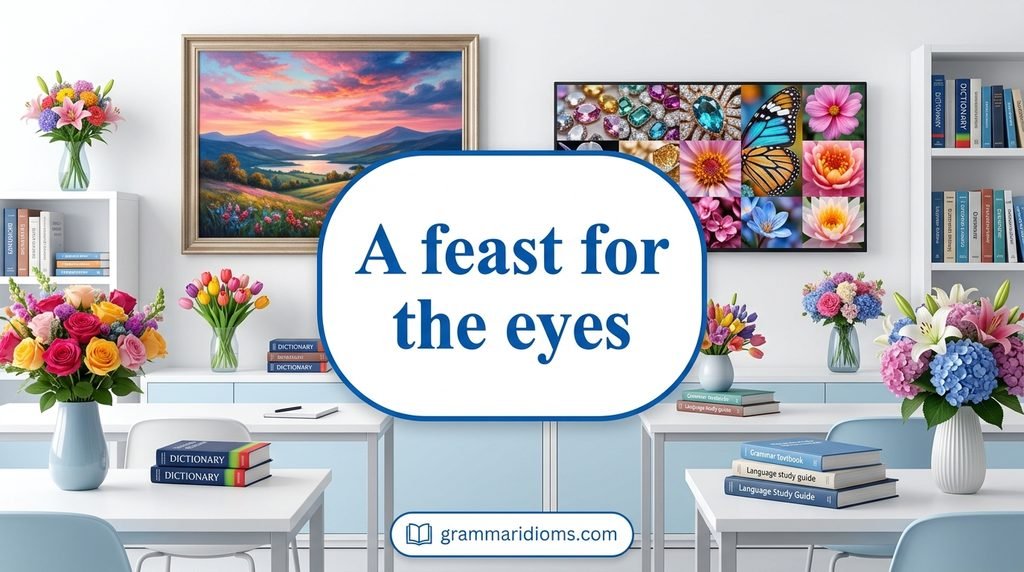
A feast for the eyes means something is extremely beautiful or visually enjoyable. Merriam-Webster defines the expression as an idiom meaning “very beautiful.”
The image compares visual beauty with the pleasure of enjoying a wonderful meal.
In a Sentence
The spring flower show was a feast for the eyes, with every display more colorful than the last.
Other Ways to Say It
- Visually stunning
- A visual delight
- Beautiful to behold
- A treat for the eyes
Explanation
This expression is especially useful when beauty comes from many visual details working together. A garden, art exhibition, fashion collection, decorated room, or spectacular landscape can all be a feast for the eyes.
It sounds more expressive than simply saying something is beautiful.
Best Use: Descriptive writing, travel writing, reviews, captions, speeches, and creative prose.
Tone: Appreciative, vivid, and slightly literary.
Common Mistake: It is not limited to physical beauty. Food presentation, architecture, art, and nature can all be a feast for the eyes.
Feast Your Eyes On
Meaning
To feast your eyes on something or someone means to look at them with great enjoyment, pleasure, or admiration. Cambridge labels this expression literary.
In a Sentence
Visitors could feast their eyes on the intricate details of the historic palace.
Other Ways to Say It
- Admire
- Enjoy the sight of
- Gaze at
- Take in
Explanation
This expression focuses on the act of enjoying beauty, rather than simply stating that something is beautiful. The metaphor treats the eyes almost like someone enjoying a delicious meal.
Because it has a literary flavor, it can sound more dramatic than everyday phrases such as “look at.”
Best Use: Creative writing, travel descriptions, storytelling, literary prose, and enthusiastic commentary.
Tone: Literary, expressive, and appreciative.
Common Mistake
Do not use it for ordinary quick glances. It suggests that someone is taking pleasure in what they see.
Take Your Breath Away
Meaning
If something takes your breath away, it surprises and impresses you so strongly that you are temporarily speechless. It is commonly used for exceptional beauty or excitement. Cambridge gives beautiful scenery as a typical example.
In a Sentence
The bride’s entrance took everyone’s breath away.
Other Ways to Say It
- Leave someone speechless
- Astonish
- Stun
- Leave someone amazed
Explanation
This is stronger than saying something is attractive. It suggests an intense emotional reaction to beauty, grandeur, or excitement.
A breathtaking sunset, magnificent dress, impressive performance, or stunning piece of architecture can all inspire this expression.
Best Use: Emotional writing, storytelling, compliments, travel writing, speeches, and special occasions.
Tone: Dramatic, emotional, and enthusiastic.
Common Mistake: It does not literally mean that someone’s breathing stops. It describes a powerful emotional reaction.
Knock Someone’s Socks Off
Meaning
To knock someone’s socks off means to impress, amaze, or stun someone very strongly. It is an informal idiom.
In a Sentence
That custom-made gown is going to knock everyone’s socks off at the awards ceremony.
Other Ways to Say It
- Amaze someone
- Wow someone
- Blow someone away
- Impress someone greatly
Explanation
This expression is useful when beauty creates a big reaction. Unlike “easy on the eyes,” which can be understated, this idiom is energetic and enthusiastic.
It works particularly well when describing a dramatic outfit, makeover, performance, design, or transformation.
Best Use: Casual conversation, entertainment writing, social media, friendly compliments, and enthusiastic reactions.
Tone: Informal, playful, and emphatic.
Common Mistake
It is normally used with an object such as someone’s or their: “The look knocked me off my socks” is not the standard form.
Look Like a Million Dollars
Meaning
To look like a million dollars means to look extremely attractive, impressive, or stylish. In U.S. English, look like a million bucks is also common.
In a Sentence
You look like a million dollars in that navy suit.
Other Ways to Say It
- Look fantastic
- Look amazing
- Look fabulous
- Look incredibly stylish
Explanation
The expression connects an impressive appearance with the imagined value of a million dollars. It often suggests that someone looks polished, confident, expensive, or exceptionally good.
It can also describe a room, car, home, or other object after an impressive makeover.
Best Use: Casual compliments, fashion conversations, celebrations, weddings, parties, and makeover descriptions.
Tone: Positive, informal, and enthusiastic.
Common Mistake: The expression does not mean the person literally has a million dollars.
Dressed to the Nines
Meaning
Dressed to the nines means wearing very fashionable, formal, or elaborate clothing, especially for a special occasion. Cambridge classifies it as an informal idiom.
In a Sentence
Everyone was dressed to the nines for the charity gala.
Other Ways to Say It
- Dressed up
- Dressed elegantly
- Dressed smartly
- Dressed in one’s finest clothes
Explanation
This idiom focuses primarily on clothing and presentation, not natural physical beauty. It is useful when someone has made a deliberate effort to look polished.
It can apply to any gender and works especially well for parties, weddings, formal dinners, award ceremonies, and other occasions where people dress up.
Best Use: Everyday conversation, event descriptions, fashion writing, and storytelling.
Tone: Informal, stylish, and upbeat.
Common Mistake
“Dressed to the nines” refers to an impressive level of dress. It does not necessarily mean someone is physically beautiful.
Dressed to Kill
Meaning
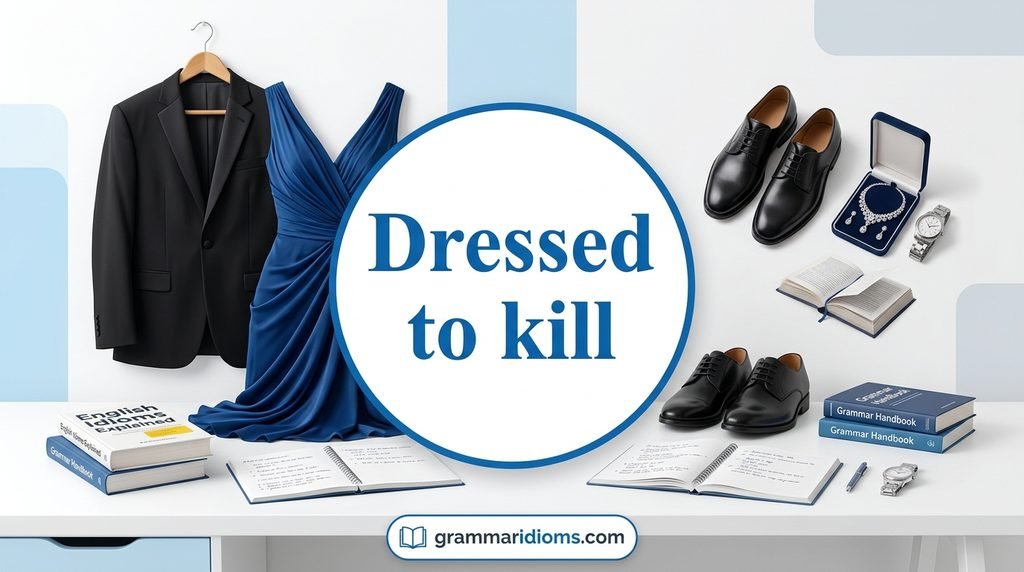
Dressed to kill means intentionally wearing stylish or striking clothes designed to attract attention and admiration. Cambridge classifies it as an idiom.
In a Sentence
He arrived dressed to kill, wearing a perfectly tailored tuxedo.
Other Ways to Say It
- Dressed to impress
- Dressed very stylishly
- Looking glamorous
- Dressed for maximum impact
Explanation
This expression has more dramatic and attention-seeking energy than “dressed to the nines.” It suggests that someone’s outfit is intended to make an impression.
The phrase can sometimes carry a flirtatious or sexually attractive implication, so context matters.
Best Use: Casual conversation, fashion commentary, party descriptions, and playful writing.
Tone: Informal, dramatic, glamorous, and sometimes flirtatious.
Common Mistake
Do not interpret “kill” literally. It is a hyperbolic expression about making a powerful visual impression.
Dolled Up
Meaning
Dolled up means dressed, groomed, or prepared in a particularly attractive or fancy way, often for a special occasion. Dictionary.com identifies it as a colloquial idiomatic expression.
In a Sentence
We all got dolled up before heading to the anniversary dinner.
Other Ways to Say It
- Dressed up
- Glammed up
- Made an effort with one’s appearance
- Looking fancy
Explanation
The expression comes from the image of making someone or something look as attractive as a pretty doll. Today, it is usually playful and informal.
It can describe clothing, hair, makeup, or overall grooming, but it should not be confused with a formal description of professional styling.
Best Use: Casual conversation, friendly messages, social posts, and informal storytelling.
Tone: Playful, casual, and lighthearted.
Common Mistake
“Dolled up” is informal. It may sound too casual for a formal report, academic essay, or professional document.
Cut a Fine Figure
Meaning
To cut a fine figure means to look impressive or admirable, especially because of one’s appearance or clothing. Cambridge labels this idiom old-fashioned.
In a Sentence
The groom cut a fine figure in his classic black suit.
Other Ways to Say It
- Look impressive
- Look distinguished
- Make a stylish impression
- Look elegant
Explanation
This expression has a distinctly traditional and polished feel. It is particularly useful when someone’s overall appearance makes them seem confident, elegant, or distinguished.
It is less common in casual modern conversation than “look great,” but it can add character to formal or historical writing.
Best Use: Literary writing, historical contexts, formal descriptions, and polished storytelling.
Tone: Old-fashioned, elegant, and admiring.
Common Mistake
Do not use it when you simply mean someone is physically attractive. The expression emphasizes the impression created by appearance and presentation.
Cut a Dash
Meaning
To cut a dash means to make a stylish, striking, or attractive appearance, particularly through clothing. It is often marked as British, informal, and old-fashioned.
In a Sentence
She cut a dash in a bright red coat and polished boots.
Other Ways to Say It
- Look stylish
- Make a striking impression
- Dress smartly
- Look fashionable
Explanation
This expression is especially useful for someone whose appearance stands out from the crowd. It suggests style, confidence, and a certain flair rather than quiet attractiveness.
Because it is old-fashioned, it can sound charming in period writing or playful modern prose.
Best Use: British English, literary writing, fashion commentary, and historical storytelling.
Tone: Stylish, old-fashioned, and slightly playful.
Common Mistake
American readers may understand it, but it is not among the most common modern U.S. expressions.
Your Best Bib and Tucker
Meaning
Your best bib and tucker means your finest or dressiest clothes, especially clothes worn for a special occasion. Cambridge labels it mainly UK and old-fashioned.
In a Sentence
Grandpa put on his best bib and tucker for the family portrait.
Other Ways to Say It
- Your finest clothes
- Your Sunday best
- Your dressiest outfit
- Your best attire
Explanation
This colorful phrase has historical roots in older clothing terms, but today it survives as a humorous way to talk about dressing up.
It is much less common than “dressed to the nines,” so it is best treated as a vocabulary-building expression rather than an everyday American phrase.
Best Use: Humorous writing, British English, historical writing, storytelling, and playful conversation.
Tone: Humorous, old-fashioned, and charming.
Common Mistake
Do not assume modern speakers will use this phrase frequently. It is recognized English, but it is relatively uncommon.
Not a Hair Out of Place
Meaning
If someone has not a hair out of place, their appearance is extremely neat, tidy, and carefully arranged. Cambridge classifies it as an idiom.
In a Sentence
Even after a long day of meetings, she looked immaculate, not a hair out of place.
Other Ways to Say It
- Immaculately groomed
- Perfectly neat
- Flawlessly arranged
- Perfectly put together
Explanation
The expression focuses on precision and grooming rather than natural physical beauty. It creates a vivid image of someone whose appearance is so carefully maintained that even one strand of hair seems out of position.
It is particularly effective when describing formal events or someone known for polished presentation.
Best Use: Descriptive writing, fashion commentary, storytelling, and formal-event descriptions.
Tone: Admiring, polished, and slightly dramatic.
Common Mistake
It is an exaggeration. It does not literally require every single hair to remain perfectly positioned.
From Head to Toe

Meaning
From head to toe means completely over the whole body. When describing appearance, it can show that someone is dressed or styled consistently from top to bottom. Cambridge classifies it as an idiom.
In a Sentence
She was dressed from head to toe in soft pastel colors.
Other Ways to Say It
- From top to bottom
- All over
- Completely
- From head to foot
Explanation
This idiom is useful when beauty or style comes from a complete look rather than one feature. Hair, clothing, shoes, and accessories can all work together to create a coordinated appearance.
It can also be used for colors, patterns, makeup, or protective clothing.
Best Use: Fashion writing, descriptive prose, everyday conversation, and visual descriptions.
Tone: Neutral and descriptive.
Common Mistake
The phrase does not automatically mean “beautiful.” It describes completeness, so the context determines whether the overall appearance is attractive.
All Eyes Are On
Meaning
If all eyes are on someone or something, everyone is watching or paying close attention to them. Cambridge and Merriam-Webster both classify this as an idiom.
In a Sentence
As the model stepped onto the stage, all eyes were on her.
Other Ways to Say It
- Everyone was watching
- Everyone’s attention was focused on
- All attention was on
- Everyone was looking at
Explanation
This expression does not directly mean beautiful. Instead, it describes the attention that beauty, style, performance, or presence can attract.
That makes it useful when discussing fashion shows, weddings, red carpets, celebrations, or any moment when someone’s appearance becomes the center of attention.
Best Use: Storytelling, event descriptions, journalism, speeches, and social-media writing.
Tone: Neutral, dramatic, and attention-focused.
Common Mistake
Being the focus of attention does not necessarily mean someone is attractive. People can attract attention for many different reasons.
Steal the Show
Meaning
To steal the show means to become the most noticeable, admired, or impressive part of an event or situation. Cambridge identifies it as an idiom.
In a Sentence
Her vintage gown stole the show at the awards ceremony.
Other Ways to Say It
- Get all the attention
- Outshine everyone
- Become the highlight
- Be the star of the event
Explanation
Beauty can “steal the show” when an outfit, hairstyle, decoration, person, or visual display attracts more admiration than everything around it.
The expression is especially useful because it suggests competition for attention, not merely attractiveness.
Best Use: Entertainment writing, event recaps, social media, storytelling, and casual conversation.
Tone: Informal, lively, and dramatic.
Common Mistake
The phrase is not limited to physical beauty. A performance, joke, animal, design, or unexpected moment can also steal the show.
Steal the Limelight
Meaning
To steal the limelight means to receive more attention than anyone or anything else in a situation. Cambridge classifies it as an idiom.
In a Sentence
Her elegant entrance stole the limelight before the ceremony had even begun.
Other Ways to Say It
- Grab attention
- Become the center of attention
- Outshine others
- Take the spotlight
Explanation
“Steal the limelight” is closely related to “steal the show,” but it emphasizes attention itself. A striking appearance can cause people to notice one person more than everyone else.
It works particularly well for red-carpet events, public appearances, fashion moments, and dramatic entrances.
Best Use: Journalism, entertainment writing, event descriptions, and informal commentary.
Tone: Dramatic, energetic, and attention-focused.
Common Mistake
Do not use it merely to mean “look beautiful.” The key idea is receiving more attention than others.
Keep Up Appearances
Meaning
Keep up appearances means maintaining an outward image that hides a less positive reality. Cambridge defines it as pretending that things are better than they really are.
In a Sentence
They spent heavily on the party mainly to keep up appearances.
Other Ways to Say It
- Maintain an image
- Preserve appearances
- Keep up a respectable image
- Hide the reality
Explanation
This idiom introduces an important critical side of beauty and appearance. It suggests that outward presentation can sometimes be used to conceal problems underneath.
That makes it useful when discussing beauty standards, social pressure, status, image, or the difference between appearance and reality.
Best Use: Essays, discussions, storytelling, social commentary, and serious writing.
Tone: Serious, critical, and sometimes negative.
Common Mistake
Do not use “keep up appearances” simply to mean dressing nicely. It usually implies pretending or maintaining an outward image despite a different reality.
Your Beauty Sleep
Meaning
Your beauty sleep is the sleep you need to feel and look healthy and attractive. Cambridge classifies the expression as a humorous idiom.
In a Sentence
I’m turning in early tonight because I need my beauty sleep.
Other Ways to Say It
- Get some rest
- Get a good night’s sleep
- Catch up on sleep
- Get some much-needed sleep
Explanation
This expression is usually playful. It connects rest with looking refreshed, although the phrase is more humorous than scientific.
It is common in casual conversation and works especially well when someone is joking about staying up late or preparing for an important event.
Best Use: Everyday conversation, texts, humorous captions, and friendly messages.
Tone: Playful, humorous, and informal.
Common Mistake
“Beauty sleep” is an idiomatic expression, not a medical claim that sleeping at a particular time guarantees physical beauty.
Exercise: Practice Using Idioms
Choose the best answer for each question.
1. What does “easy on the eyes” mean?
A. Difficult to understand
B. Pleasant or attractive to look at
C. Painful to see
D. Very expensive
2. Which expression describes something extremely beautiful or visually enjoyable?
A. Keep up appearances
B. From head to toe
C. A feast for the eyes
D. All eyes are on
3. Someone wearing very fashionable clothes for a formal event may be described as:
A. Dressed to the nines
B. A sight for sore eyes
C. Keeping up appearances
D. Getting beauty sleep
4. What does “take your breath away” suggest in a beauty context?
A. Someone is difficult to understand
B. Somebody is physically tired
C. Someone is trying to leave
D. Something creates strong admiration or amazement
5. Which expression means to look extremely attractive or impressive?
A. Look like a million dollars
B. Keep up appearances
C. From head to toe
D. Feast your eyes on
6. Which idiom means to dress or groom yourself in a particularly fancy way?
A. Steal the limelight
B. Dolled up
C. Not a hair out of place
D. All eyes are on
7. Which expression is mainly British, informal, and old-fashioned?
A. Cut a dash
B. Take your breath away
C. A feast for the eyes
D. Look like a million dollars
8. If someone is “not a hair out of place,” what does this suggest?
A. They are having a bad hair day
B. They have very messy hair
C. Their appearance is extremely neat
D. They have recently cut their hair
9. What does “steal the show” mean?
A. Leave an event early
B. Become the most noticeable or impressive part of an event
C. Secretly take something from a theater
D. Perform badly in public
10. Which expression is especially associated with fine or dressy clothes and is mainly UK and old-fashioned?
A. Your best bib and tucker
B. Easy on the eyes
C. Knock someone’s socks off
D. All eyes are on
11. If “all eyes are on” someone, what is happening?
A. Everyone is ignoring them
B. Everyone is watching or focusing on them
C. They are going to sleep
D. They are hiding their appearance
12. Which expression can describe sleep needed to look and feel refreshed?
A. Steal the limelight
B. Cut a fine figure
C. Your beauty sleep
D. Dressed to kill
13. Which idiom can imply that someone is maintaining an outward image despite a different reality?
A. Keep up appearances
B. Feast your eyes on
C. Dressed to the nines
D. Knock someone’s socks off
14. Which sentence uses “feast your eyes on” naturally?
A. Feast your eyes on this magnificent sunset.
B. I feasted my eyes on my homework because it was difficult.
C. She feasted her eyes on the alarm clock and went back to sleep.
D. He feasted his eyes on the door because it was locked.
15. Which expression means to make a stylish or striking appearance and is often old-fashioned?
A. Your beauty sleep
B. Cut a dash
C. Keep up appearances
D. From head to toe
Answers
- B — “Easy on the eyes” means pleasant or attractive to look at.
- C — “A feast for the eyes” describes something extremely beautiful or visually enjoyable.
- A — “Dressed to the nines” means wearing very fashionable, formal, or elaborate clothes.
- D — “Take your breath away” describes a powerful reaction of admiration, surprise, or amazement.
- A — “Look like a million dollars” means to look extremely good, attractive, or impressive.
- B — “Dolled up” means dressed or groomed in a particularly fancy or attractive way.
- A — “Cut a dash” is commonly described as British, informal, and old-fashioned.
- C — “Not a hair out of place” means someone’s appearance is exceptionally neat and well arranged.
- B — “Steal the show” means becoming the most noticeable, impressive, or admired part of an event.
- A — “Your best bib and tucker” refers to your finest clothes and is mainly UK and old-fashioned.
- B — “All eyes are on” means everyone is watching or paying close attention.
- C — “Beauty sleep” humorously refers to the sleep needed to look and feel healthy and attractive.
- A — “Keep up appearances” means maintaining an outward image that may hide a less positive reality.
- A — “Feast your eyes on” means to look at something with pleasure or admiration.
- B — “Cut a dash” means to make a stylish or striking appearance.
FAQs
What are some common idioms about beauty?
Common idioms about beauty include easy on the eyes, a feast for the eyes, and look like a million dollars. These phrases help describe beautiful people, places, and things naturally.
How can idioms help me describe beauty?
Idioms help you express beauty with more detail than simple adjectives. They add elegance, charm, and visual appeal to everyday language.
What is an idiom for someone who looks very attractive?
Easy on the eyes describes someone who looks pleasant or attractive. You can also say look like a million dollars when someone looks especially stylish or impressive.
Are all beauty idioms suitable for everyday English?
No, some expressions are informal, literary, British, or old-fashioned. For practical usage, check the tone and context before using less common idioms.
How can I practice using idioms for beauty?
Start by learning each meaning and then write simple sentences using realistic situations. This helps you understand when it sounds natural and improves your English vocabulary.
Conclusion
These idioms about beauty make it easier to describe beauty with vivid, natural phrases. From easy on the eyes to take your breath away, each expression adds charm, elegance, and personality to everyday language. Choose each idiom by its meaning, tone, and context to make your sentences sound clear and natural.
